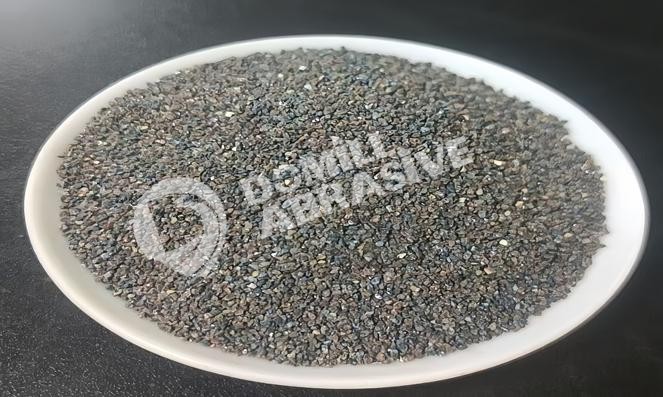
DOMILL ATB58 In-Situ Annealed Tough BFA is an engineered composite abrasive grain designed to provide resinoid abrasive wheel manufacturers with high performance at optimized cost.
To overcome the high purchasing price and heavy carbon footprint associated with secondary tunnel-kiln calcined alumina (Blue Calcined BFA), DOMILL utilizes the thermal energy present at the furnace ladle core during electric-arc furnace (EAF) smelting to achieve In-Situ Thermal Annealing.
Raw materials for ATB58 are harvested from heavily agglomerated blocks produced in the ladle core zone (>1350∘C). Over tens of hours of exposure to molten liquid and controlled slow cooling, Ti4+ titanium ions solid-dissolve into the corundum crystal lattice, yielding a dense microstructure. Meanwhile, grains annealed in the 1050∘C–1350∘C zone undergo stress relief, eliminating residual micro-strains. Processed via specialized roll crushing and dual 8000 Gauss high-intensity magnetic separation, ATB58 delivers three core features: single-particle crush strength comparable to calcined BFA, isodiametric blocky grain geometry with minimal needle/flake particles, and ultra-low free iron content.
When applied in 400mm–600mm heavy-duty resinoid cutting discs, depressed center grinding wheels, and high-speed snagging wheels, ATB58 increases wheel packing density and dynamic balance. It mitigates micro-fissure expansion risks during 200∘C curing, enhancing wheel durability and cut-off efficiency.
( Operational Guidance: Specifically optimized for resinoid bonded abrasives and heavy snagging. For vitrified grinding wheels, ultra-clean non-ferrous blasting, or aerospace precision grinding requiring 100% blue phase, upgrade to DOMILL Blue Calcined BFA or DOMILL White Fused Alumina (WFA) series.)
Micro-Fissures & Wheel Explosion from Free Iron Expansion: Residual magnetic free iron expands during 180∘C–200∘C resin curing, generating internal micro-cracks that cause wheel breakage at 80 m/s operating speeds. ATB58 undergoes dual 8000 Gauss magnetic separation, eliminating iron expansion hazards.
Low Bulk Density & Excess Resin Consumption from Flake Grains: Needle-like and flaky grains create voids, lowering bulk density and increasing resin consumption. ATB58 features an isodiametric blocky shape that packs densely, ensuring uniform resin coating and dynamic balance.
Premature Grain Shattering in Heavy Cut-Off Operations: High internal lattice strain causes standard BFA grains to shatter under heavy cutting pressures, wearing wheels down prematurely. In-situ thermal annealing boosts single-particle crush strength by 15%–25%, extending wheel life.
3.1 Physical & Chemical Specifications Table
|
Classification |
Property / Element |
Control Specification / Typical Value |
Technical Context & Guidance |
|
Physical Spec |
Particle Shape |
Isodiametric Blocky / Cubical |
Flake/needle ratio <8%; optimizes wheel packing density |
|
|
Appearance / Color |
Composite Blue-Brown Interspersed |
Contains >1350∘C solid-dissolved blue phase & brown phase |
|
|
Specific Gravity |
≥3.92 g/cm3 |
Fully developed crystal lattice with minimal porosity |
|
|
Bulk Density |
F24 Typical: 1.85–1.93 g/cm3 |
High bulk density reduces resin binder consumption |
|
|
Mohs Hardness |
9.0 Mohs (Microhardness 2000–2200 kg/mm2) |
Combines hardness with impact toughness |
|
|
Magnetic Free Iron |
<0.005% (Dual 8000 Gauss Separated) |
Protects against micro-cracking during 200∘C resin curing |
|
|
Crush Strength |
15%–25% higher than standard BFA |
Comparable to calcined BFA; resists premature breakdown |
|
Chemical Analysis |
Al2O3 |
95.00% – 97.00% |
High-purity corundum crystalline matrix |
|
|
TiO2 |
1.80% – 3.00% (Toughening Phase) |
High dissolved titanium content enhancing fracture toughness |
|
|
Fe2O3 |
<0.30% |
Low bound iron oxide content |
|
|
SiO2 |
<1.00% |
Low silica content eliminates low-melting glassy phases |
4.1 FEPA-F Standard Grit Specifications Table
|
FEPA Grit |
Nominal Size (μm) |
Bulk Density (g/cm3) |
Primary Bonded Abrasive Application |
Performance Characteristic |
|
F16 |
1000 – 1400 μm |
1.88–1.95 g/cm3 |
500mm–600mm heavy snagging wheels, steel billet grinders |
Resists ultra-high pressure; high shatter resistance |
|
F20 |
850 – 1180 μm |
1.86–1.94 g/cm3 |
400mm–500mm railway rail cutting discs, heavy snagging |
Engineered for rapid cutting of high-tensile rail steels |
|
F24 |
710 – 1000 μm |
1.85–1.93 g/cm3 |
400mm Workhorse Grade for Resinoid Cutting Discs |
Industry workhorse size; optimizes wheel packing density |
|
F30 |
600 – 850 μm |
1.83–1.91 g/cm3 |
350mm–400mm cut-off wheels, foundry grinding discs |
Balances cutting speed with low vibration and balance |
|
F36 |
500 – 710 μm |
1.80–1.88 g/cm3 |
Angle grinder depressed center wheels, weld grinders |
Combines self-sharpening ability with resin adhesion |
|
F46 / F54 |
300 – 500 μm |
1.76–1.84 g/cm3 |
Precision thin resin wheels, slotting wheels |
Delivers clean cuts with low heat generation |
|
F60 |
212 – 300 μm |
1.72–1.80 g/cm3 |
Fine grinding depressed center wheels, slotting tools |
Provides uniform surface finishes without thermal distortion |
In-Situ Annealed Peak Toughness: Harnesses natural 1350∘C+ furnace-bed heat for slow annealing, fully dissolving Ti4+ into the lattice. Boosts single-particle crush strength by 15%–25% over standard BFA.
Isodiametric Blocky Geometry & High Density: Specialized roll-crushing reduces flake/needle ratios to <8%, raising bulk density to 1.85–1.93 g/cm3 (F24). Ensures uniform resin encapsulation and dynamic balance.
Dual 8000 Gauss Magnetic Free Iron Control: Dual-pass 8000 Gauss magnetic separation reduces magnetic free iron to <0.005%, preventing micro-crack generation during 200∘C resin heat curing.
Double Homogenized Batch Consistency:Supported by a 400-ton buffer stock with bulk mixing and gravity blending, flattening single-furnace variations to secure long-term batch consistency.
6.1 Commercial Selection & Generational Upgrade Matrix
|
Wheel Type & Application |
Recommended Abrasive |
Selection Rationale & Upgrade Benefit |
Cost & Efficiency Impact |
|
400mm–600mm Heavy-Duty Resinoid Discs / Snagging |
DOMILL ATB58 In-Situ Annealed BFA |
Resinoid Cost-Performance Leader; medium-temp cost, near-calcined toughness, high bulk density |
Maximizes disc cuts per wheel, reduces breakage, optimizes profit margins |
|
Ultra-High Speed / Aerospace Precision Resinoid |
Upgrade to DOMILL Blue Calcined BFA |
Performance Jump (Tunnel Kiln 1050°C–1300°C); 100% blue phase, superior hydrophilicity (+300%) |
Maximizes resin bonding for high-G-ratio premium abrasive grinding |
|
Vitrified Bonded Wheels / Zero Iron & Colorless Prep |
Upgrade to DOMILL White Fused Alumina (WFA) |
Material Jump (Al2O3≥99%); Mohs 9.0 hardness, pure white color, 100% zero iron |
Prevents dark spots in high-temp vitrified firing; ideal for burn-free precision grinding |
6.2 Detailed Upgrade Guidance
Case 1: 400mm–600mm Ultra-Thin Resinoid Cutting Wheels & Heavy-Duty Depressed Center Grinding Wheels $\rightarrow$ Select DOMILL ATB58
Ideal for manufacturers seeking near-calcined cutting durability for heavy-duty cutting discs while controlling raw material expenditures.
Case 2: High-Value Ultra-High-Speed Grinding Wheels / Pursuing Ultimate Resin Adhesive Wetting & Bonding Strength $\rightarrow$ Upgrade to [DOMILL Blue Heat-Treated Calcined BFA]
ATB58 features a blue-brown composite phase. For wheels requiring 100% pure blue phase and maximum surface hydrophilicity for resin wetting, upgrade to DOMILL Blue Calcined BFA.
Case 3: Vitrified Bonded Grinding Wheels or Requiring Ultra-High Cleanliness $\rightarrow$ Upgrade to [DOMILL White Fused Alumina (WFA)]
Vitrified wheels undergo high-temperature firing (>1200∘C), where titanium/iron oxides in BFA can cause dark specks. For vitrified tools, upgrade to DOMILL White Fused Alumina (Al2O3≥99%).
1. 400mm–600mm Heavy-Duty Cutting Discs: Engineered for heavy-duty cutting discs sectioning steel rails, structural steel, and steel castings without grain crumbling.
2. Depressed Center Snagging Wheels: Applied in foundry snagging wheels and shipyard weld grinders, providing high removal rates under heavy downforce.
3. High-Speed Bonded Abrasive Tools: Utilized in high-speed (80 m/s+) resinoid wheels where low free-iron content safeguards against breakage caused by curing cracks.
Q: How does ATB58 achieve near-calcined toughness without undergoing secondary tunnel-kiln firing?
A: Traditional calcined BFA requires secondary firing in tunnel kilns (1050∘C–1300∘C) to relieve internal strain and solid-dissolve titanium. DOMILL utilizes the natural heat of the ladle core (>1350∘C) during EAF smelting. Agglomerated blocks undergo In-Situ Thermal Annealing under molten liquid over tens of hours. This natural slow cooling yields lattice strain relief and titanium solid-solution, delivering high toughness while eliminating secondary energy costs.
Q: Why are "Bulk Density" and "Magnetic Free Iron" more critical than chemical purity in heavy-duty resinoid wheel manufacturing?
A:
1. Bulk Density: Dictates wheel packing density. Flaky grains create voids, lowering bulk density and increasing resin consumption while impairing wheel dynamic balance. ATB58’s high bulk density (1.85–1.93 g/cm3 for F24) ensures tight packing and uniform resin coating;
2. Magnetic Free Iron: Resinoid wheels undergo heat curing at 180∘C–200∘C. Free iron particles expand faster than corundum or resin under heat, cracking the resin matrix and creating micro-fissures. Dual 8000 Gauss magnetic separation reduces free iron to <0.005%, protecting against breakage during high-speed operation.
Please fill out the form.We will reply you in 24 hours.