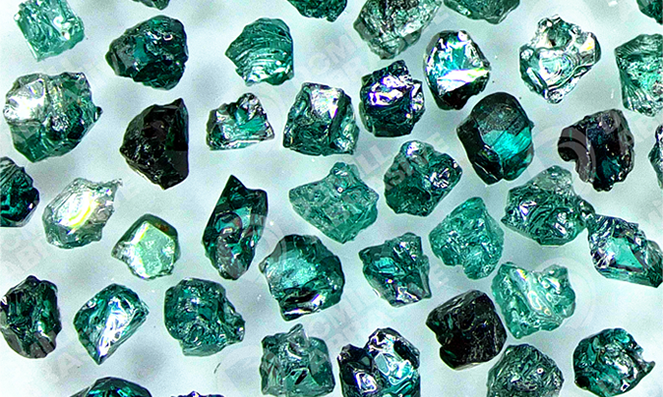
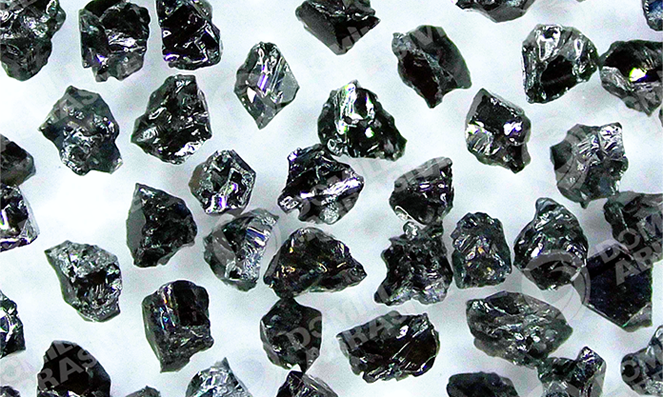
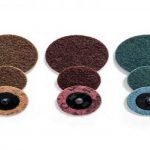
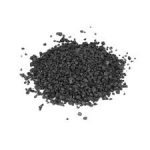
The DOMILL Silicon Carbide (SiC) series is specifically engineered for bonded abrasive tools, coated abrasive products, and industrial surface blasting media. Synthesized via the Acheson resistance furnace process at 2000 °C–2500 °C using top-grade quartz sand and petroleum coke, DOMILL SiC is dominated by the hexagonal α-SiC crystal structure. Featuring a Mohs hardness of 9.2–9.5, it provides substantially higher hardness, thermal conductivity, and sharp micro-cleavage compared to fused alumina.
To address the stringent technical demands of abrasive manufacturing and surface treatment, DOMILL incorporates airflow shaping, chemical leaching, and strict hydraulic classification pathways. Black SiC (SiC ≥ 98%) provides high toughness and cost-efficiency for cast iron grinding wheels, non-ferrous sanding belts, and heavy-duty blasting; Green SiC (SiC ≥ 99%) delivers superior purity and razor-sharp self-sharpening kinetics tailored for tungsten carbide grinding, titanium alloy finishing, and micro-blasting etching applications.

In bonded wheel production, coated belt coating, and surface blasting operations, low-grade SiC causes premature grain shedding and unacceptable surface defects. DOMILL's engineered SiC portfolio directly eliminates these performance bottlenecks:
Wheel Loading & Surface Thermal Burn: When grinding grey cast iron or tungsten carbide, standard abrasives dully glaze over, increasing grinding drag and thermal burns. DOMILL SiC maintains micro-spalling sharp cleavage edges under shear stress to ensure low cutting force and minimal heat generation.
Poor Electrostatic Orientation & Grain Shedding in Coated Tools: Irregular grain aspect ratios cause poor electrostatic orientation during sanding belt production, leading to flat-lying grains and weak resin bonding. DOMILL provides shape-tailored Black and Green SiC P-grains to ensure optimal orientation and extended belt longevity.
Rogue Oversized Grain & Inconsistent Blast Finish: Rogue coarse particles cause deep catastrophic scratches during surface blasting on precision components. DOMILL Blasting Grade SiC enforces strict upper-particle-size limits (D100 cutoffs) to produce uniform, repeatable surface anchor patterns.
| Grade Series | Core Physical Morphology Trait | Target Application Scenarios | Why Choose This Series? |
|---|---|---|---|
| Black Silicon Carbide (Black SiC) | Black polyhedral grains, SiC ≥ 98.0%; higher mechanical toughness, sharp cleavage edges, and high thermal conductivity. | Resinoid/vitrified wheels for cast iron and non-ferrous metals, sanding belts for stone/rubber/leather, metal & glass surface blasting. | High cost-performance ratio for bonded tools, coated belts, and general blasting. Slightly lower hardness than Green SiC but offers better toughness under mechanical impact. |
| Green Silicon Carbide (Green SiC) | Bright green translucent sharp crystals, SiC ≥ 99.0%; Mohs 9.5 hardness, extreme friability, and razor-sharp cutting points. | Tungsten carbide tool sharpening wheels, titanium alloy grinding tools, precision micro-blasting, optical/ceramic blast etching. | Designed for ultra-hard, brittle, or thermal-sensitive workpieces. High friability continuously generates sharp cutting points for precise, low-force grinding and blasting. |
DOMILL Silicon Carbide delivers high performance across bonded tools, coated products, and blasting applications through targeted manufacturing standards:
Extreme Hardness & Sharp Cleavage Mechanism: Vickers hardness of 2800–3400 kg/mm² provides immediate depth-of-cut. During grinding, grains rupture along cleavage planes into micro-sharp fragments, maintaining low shearing forces.
Tailored Grain Morphology for Bonding & Coating: Provides isometric high-bulk-density F-grains for bonded wheels and sharp, high-aspect-ratio P-grains for electrostatic-coated belts and flap discs, optimizing both cutting efficiency and bond anchorage.
Strict PSD & Zero Oversize Particle Guarantee: Strictly compliant with FEPA, JIS, and ISO standards. Multi-stage classification eliminates coarse tails (D100 control), preventing scratch defects on coated abrasive surfaces and blasted workpieces.
1. Bonded Abrasives
Cast Iron Snagging Wheels: Utilizes Black SiC (C Series F-Grains) for resinoid snagging wheels, cut-off discs, and grinding hubs to rapidly slice through grey and ductile cast iron matrices without loading.
Tungsten Carbide & Titanium Grinding Wheels: Utilizes Green SiC (GC Series F-Grains) in vitrified and resinoid wheels to sharpen tungsten carbide drills, end mills, inserts, and titanium alloy components with zero thermal damage.
2. Coated Abrasives
Stone, Rubber & Leather Sanding Belts/Papers: Utilizes Black SiC (C Series P-Grains) for coated sandpapers, flexible stone discs, and rubber/leather sanding belts, slicing through resilient flexible fibers cleanly.
Carbide & Gemstone Polishing Discs: Utilizes Green SiC (GC Series P-Grains) for electrostatic coated belts and precision finishing discs, providing scratch-free, mirror-like surfaces on carbides and gemstones.
3. Blasting & Surface Preparation
Heavy-Duty Industrial Blasting: Black SiC blasting media effectively cleans heavy cast iron, stainless components, and steel molds while imparting uniform surface anchor patterns with long recycling lifespans.
Precision Micro-Blasting & Glass Etching: Green SiC micro-blasting powders are ideal for glass etching, printed circuit board (PCB) cleaning, semiconductor fixture micro-blasting, and precision carbide deburring.
Q: How do I choose between Black SiC (C) and Green SiC (GC) for manufacturing grinding wheels and sanding belts?
A: Selection depends on the target substrate's hardness, toughness, and thermal sensitivity:
Select Black SiC (C): For grey iron, ductile iron, brass, aluminum, natural stone, rubber, and leather. Black SiC provides high hardness combined with optimal toughness, maximizing cost-efficiency for lower-tensile metals and non-metallic workpieces.
Select Green SiC (GC): For tungsten carbide, titanium alloys, optical glass, gemstones, and structural ceramics. Green SiC offers supreme Mohs 9.5 hardness and high friability for razor-sharp micro-spalling under low normal pressure, suppressing thermal micro-cracking and work-hardening.
Q: How does DOMILL SiC blasting media guarantee consistent surface roughness without deep scratch defects?
A: Deep scratch defects during surface blasting stem from rogue oversized grains (D100 contamination). DOMILL Blasting Grade SiC uses precision closed-loop sieving and hydraulic classification to restrict upper particle size limits. Combined with optimized grain shape processing, the grains deliver consistent kinetic impact and uniform anchor profile depth across workpieces.