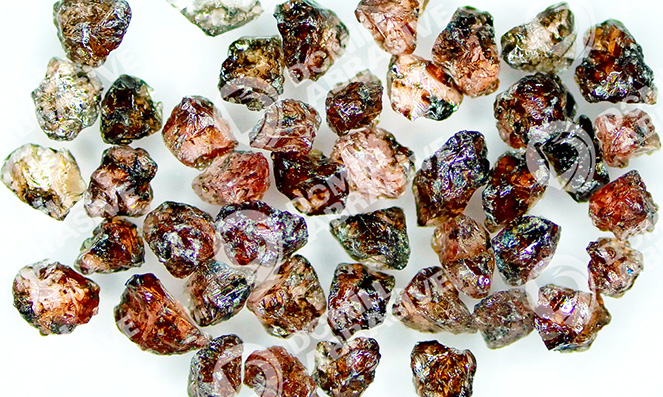
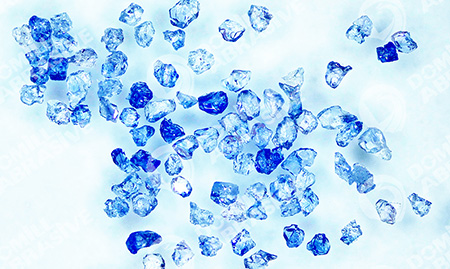
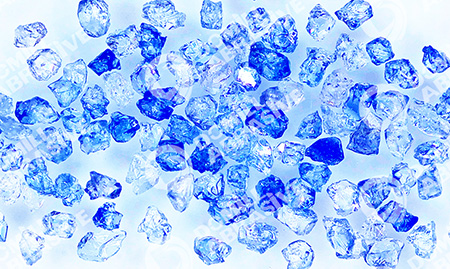
The DOMILL Treated & Calcined Brown Fused Alumina (BFA) series represents our premium modified matrix engineered to transcend the physical and chemical limitations of generic commodity abrasives.
Through precision thermal processing ranging from 1050°C to 1350°C paired with advanced nano-ceramic surface coatings (ceramic red/glazing), this series deeply reconstructs both the internal crystal lattice and interfacial particle dynamics. It eliminates internal micro-stresses, heals lattice defects, and drastically optimizes surface hydrophilicity and micro-roughness. It delivers unparalleled tool lifespan extensions and grinding efficiencies for high-performance bonded and coated tools---such as high-speed resinoid wheels, heavy snagging wheels, and ultra-wide heavy-duty belts---where maximum grinding ratios and zero grain-shedding are paramount.
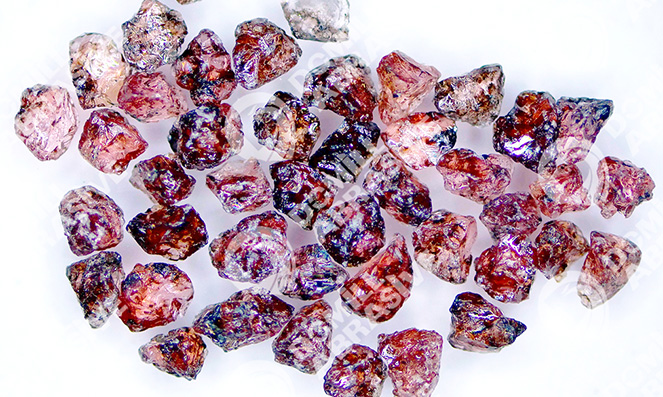
Industry Challenges Solved: As modern manufacturing scales toward higher automation, extreme linear speeds, and heavy material removal rates, standard abrasives subjected to violent thermal shock and high-shear stresses suffer premature failures due to thermal brittleness or poor adhesion. The DOMILL Treated & Calcined BFA portfolio rejects commoditized grading; our crystalline lattice and interfacial chemistry are micro-engineered to eliminate systemic vulnerabilities in high-stress manufacturing lines:
Thermal Shock Shattering: Standard grains retain microscopic fractures and internal residual stresses from processing. When exposed to instantaneous grinding temperatures exceeding 1000°C, they undergo catastrophic, premature macro-cleavage, causing the grains to crumble erratically and the cut rate to plummet.
Premature Grain Pull-out: Generic, untreated BFA surfaces are excessively smooth and inherently hydrophobic, offering poor physical or chemical affinity to synthetic resin or vitrified binders. Under high-speed shear forces, they suffer whole-grain pull-out, causing premature wear and bare spots on the tool.
Debris Adhesion & Interfacial Micro-cracking: Without a transitional interface layer, grinding heat and swarf easily accumulate, while localized thermal expansion mismatches transfer directly to the binder boundary, triggering thermal burns on the workpiece or microscopic cracking within the wheel's matrix.
| Series | Technical Morphology Trait | Target Infrastructure | Why Choose This Series? (Engineering Edge) |
|---|---|---|---|
| AT Series | 1050°C Precision Thermal Healing, Stress-Relieved Lattice | High-grade vitrified wheels, medium-duty organic bond tools, precision coated tools | Eliminates internal micro-cracks.Releases mechanical micro-stresses from crushing, enhancing single-grain compressive strength and reducing unpredictable fracturing. |
| AB Series | 1350°C Ultra-High Temp Sintering, Sub-surface Recrystallization | Heavy-duty deep grinding wheels, high-speed thin cutoff wheels, rail grinding, high-tension belts | Ultimate thermal endurance and high toughness.Fires at 1350°C to burn off volatile impurities and induce phase stabilization for superior thermal shock resistance. |
| ATR Series | Medium-Temp Sintered Ceramic Nano-Coating (Ceramic Red) | Resin-bonded cutoff wheels, flap discs, general organic abrasives, medium-heavy duty belts | Dual mechanical & chemical anchoring.Sintering a rough micro-crystalline ceramic coating exponentially increases hydrophilicity, securing an unbreakable capillary bond. |
| ABR Series | Two-Stage High-Temp Treatment paired with High-Fired Glaze | Heavy-duty wide sanding belts, automated steel billet snagging wheels, extreme high-pressure lines | Unbreakable "Physico-Chemical Bridge" for extreme workloads.Combines a 1350°C calcined core with a high-melting-point glaze, providing ultimate physical anchoring and chemical adhesion. |
The outstanding tooling lifespan and operational efficiency delivered by DOMILL Treated & Calcined BFA are achieved by reconstructing the grain surfaces and lattice structures via precise thermodynamic and interface chemistry engineering:
Lattice Reconstruction & Micro-Stress Relief: By employing multi-stage controlled thermal cycles up to 1350°C, lattice distortions and mechanical micro-cracks generated during raw mineral crushing are deeply healed. This minimizes internal crystal defects, vastly improving the grain's fracture toughness under extreme centrifugal forces (high RPM) or high-pressure grinding.
Physico-Chemical Interfacial Bridging: Specifically engineered for organic and inorganic binders, our coated series (ATR/ABR) establishes a uniform, modified ceramic interface over each grain. This layer increases surface micro-roughness for powerful mechanical interlocking while eliminating BFA's natural hydrophobicity, allowing binders to completely wet the grains via capillary forces and form molecule-level chemical bridges.
Low Magnetic Content & High Thermal Volume Permanence: Through high-temperature calcination and multi-stage electromagnetic purging, unstable low-valence titanium phases are completely oxidized and free iron fractions are minimized. This eliminates hidden expansion-mismatch stresses that cause early abrasive tool cracking or aesthetic thermal spots on the workpiece.
Premium Bonded Abrasives: Engineered for high-speed, heavy-duty snagging wheels, rail cutting discs, and precision grinding wheels. The AT and AB series relieve thermal stresses and guarantee structural volume permanence. In high-shear environments, the ATR and ABR series increase binder-grain adhesion to prevent uneven wheel cracking, ensuring safe and durable cutting operations.
Elite Heavy-Duty Coated Systems: The gold-standard aggregate for ultra-wide heavy sanding belts and high-performance sanding discs. The ATR and ABR series, with their outstanding electrostatic polarization response and capillary hydrophilicity, achieve perfect vertical grain orientation in electro-coating chambers, preventing premature grain pull-out and extending belt lifespan by 30% to 50%.
High-Precision Finishing & Technical Surfacing: Applied in operations requiring flawless surface integrity (such as 3C electronic casings, titanium aerospace components, and precision hardware) to deliver balanced self-sharpening and scratch-free finishes, drastically reducing line reject rates.