Home / Products / Treated & Calcined Brown Fused Alumina (BFA) / AT: 1050 Calcined Brown Fused Alumina
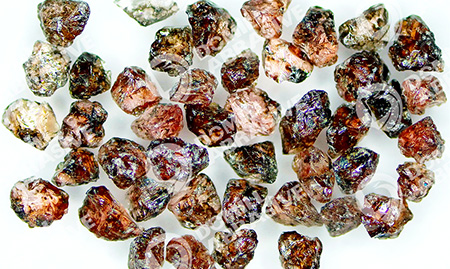
The DOMILL AT: 1050 Calcined Brown Fused Alumina series is an advanced thermally conditioned abrasive designed to transcend the physical limitations of standard grains in high-performance bonded and coated tools.
By subjecting selected high-quality BFA grains to a precise, computer-controlled thermal soaking process at 1050°C, the internal residual lattice stresses and micro-fractures induced during severe mechanical crushing are effectively relieved and thermally healed. This structural optimization dramatically augments single-grain compressive strength and volumetric stability, making the AT series the premier choice for premium vitrified grinding wheels (such as internal, gear, and crankshaft wheels), high-precision resinoid cutoff discs, and performance-grade coated abrasive belts operating under demanding high-RPM thresholds.
Beyond its superior mechanical fracture toughness, the 1050°C thermal oxidation process thoroughly volatilizes trace organic residues and oxidizes lower-valence titanium phases on the grain surfaces. This yields an exceptionally clean, highly reactive micro-capillary surface, resulting in a significant leap in hydrophilicity (capillary wetting). Combined with strictly minimized magnetic fractions, the AT series establishes an ultra-dense, void-free interfacial crosslink with vitrified binders and phenolic resins, completely mitigating premature grain shedding and bald spots, serving as the technical bedrock for enterprises to secure processing stability in mid-to-high-end precision cutting tools.
In precision automatic grinding, high-RPM thin slicing, and continuous heavy-duty sanding, hidden crystalline stresses and surface impurities in generic abrasives trigger sudden system failures. The DOMILL AT: 1050 Calcined BFA is thermally engineered to target and eliminate the following vulnerabilities:
Micro-Structural Shattering & Premature Fragmentation: Untreated abrasives retain dense mechanical micro-fractures from the crushing phase. When subjected to high-frequency cyclic loading or cutting heat shocks, these cracks propagate rapidly, triggering premature catastrophic fragmentation before the grain's cutting edge is fully utilized, compromising overall tool service life.
Binder Voiding & Thermal Stress Cracking: Residual free iron, magnetic complexes, and low-valence titanium in standard BFA undergo volume expansion and outgassing during high-temperature vitrified sintering (900°C – 1050°C) or resin curing. This creates microscopic air pockets and thermal stress spots within the binder matrix, critically reducing rotational burst strength.
Poor Interfacial Wet-out & Premature Grain Pull-out: Untreated BFA surfaces are inherently hydrophobic and possess low surface energy, preventing complete wet-out by viscous liquid resins or vitrified glazes. Under high-speed, heavy-shear grinding loads, the mechanical interlock fails, resulting in premature whole-grain pull-out.
Technical Context: The calcined modification process reshapes the crystalline lattice while thermalizing volatile impurities. For standardized technical comparison, the physical and chemical specifications of the DOMILL AT series are strictly benchmarked using FEPA F36 grit size as the baseline.
| Parameter | Specification (FEPA F36 Standard) | Test Benchmark & Method |
| Al₂O₃ Content | ≥ 95.50% | GB/T 3043 / ISO 9286 |
| TiO₂ Content | 1.50% – 3.00% | X-Ray Fluorescence (XRF) |
| Fe₂O₃ Content | ≤ 0.10% | Acid Extraction Titration |
| Magnetic Content | ≤ 0.0015% | High-Field Magnetic Separator |
| Calcination Temperature | 1050 °C (Precision-controlled electric kiln) | Thermocouple Temperature Array |
| Capillary Hydrophilic Rise | ≥ 60 mm / 10 min | Capillary Water Rise Test |
| Single-Grain Compressive Strength Improvement | +15% – 25% (vs. conventional A1 fused alumina) | L75 Single-Grain Crushing Test |
| Bulk Density | 1.82 – 1.95 g/cm³ | FEPA Standard 44-GB-1986 |
Crystalline Self-Healing & Superior Fracture Toughness: The precise 1050°C thermal treatment provides critical activation energy, triggering atomic rearrangement to self-heal micro-fractures induced during severe crushing. This dramatically elevates single-grain compressive strength, enhancing wear durability under high-speed grinding while eliminating erratic grain crumbling.
Ultra-Low Magnetic Fractions & Enhanced Sintering Stability: By integrating advanced multi-stage electromagnetic purging with high-temperature oxidation, trace free iron and magnetic fractions are converted into inert, stable oxides. This completely eliminates thermal stress cracking and iron-burn spots during the 900°C – 1050°C sintering of premium vitrified tools, maximizing finished product safety.
Micro-Capillary Hydrophilic Surface & Superior Interfacial Cohesion: The high-temperature treatment completely strips off the hydrophobic organic film on the grain surfaces, significantly increasing surface energy and micro-roughness. During binder mixing, liquid resins or glazes wet the micro-cavities seamlessly, creating molecular-level mechanical interlocking that prevents grain pull-out under severe shear.
1. High-Grade Precision Vitrified Grinding Wheels
AT58: The premier choice for premium vitrified crankshaft wheels, gear wheels, and internal bearing grinding tools operating at high linear speeds. The ultra-low magnetic fraction and outstanding thermal stability of the AT series eliminate structural warping or cracking during sintering, ensuring flawless finish integrity on critical parts.
2. High-Performance Resinoid Cut-Off & Thin Slicing Discs
AT18: Specially deployed for performance-grade ultra-thin resinoid cutting and grinding wheels. Its stress-relieved, high-compressive-strength grains ensure a steady self-sharpening rhythm when cutting stainless steel and hardened alloys, maximizing cut rates and grinding ratios.
3. Performance Coated Abrasive Belts & Discs
AT22: Optimized for premium paper/cloth-backed sanding belts and vulcanized fiber discs. The elevated electrostatic sensitivity paired with its active hydrophilic surface ensures 100% resin adhesive wet-out, preventing premature grain shedding or loading under high-tension sanding conditions.
The AT series perfectly covers high-performance tools with demanding requirements for bonding strength and toughness. However, under lower-stress economic baselines or ultra-high extreme processing thresholds, specify other grades according to these engineering boundaries:
If operating in bulk, cost-sensitive generic tooling or single-pass blasting: Transition to the A1: Regular Brown Fused Alumina to optimize baseline economic efficiency.
Under severe steel billet snagging or extreme high-pressure rail cutting where thermal shock exceeds 1100°C: Upgrade to the AB: 1350 Calcined Brown Fused Alumina to utilize its deeply crystallized, ultra-high temperature grain stability.
For heavy-shear resinoid wheels or sanding discs experiencing severe abrasive pull-out: Upgrade to the ATR: Standard Ceramic Coated BFA to benefit from its micro-crystalline ceramic coating which forms a powerful mechanical-chemical anchoring bridge.
For high-end automated wide belts in high-tension aerospace or heavy machinery polishing: Specify the ABR: Two-Stage High-Toughness Coated BFA to leverage its high-fired ceramic-melt integration.
Q: How does the 1050°C thermal calcination process physically eliminate crystalline micro-stresses to minimize premature shattering?
A: During high-impact mechanical crushing, standard BFA grains undergo massive shear stresses and crushing forces, which create dense, hidden micro-fractures and lattice dislocations (residual internal stress) within the crystal matrix. When grinding, these hidden defects propagate uncontrollably under alternating mechanical loads and grinding heats (which can spike above 1000°C), triggering premature shattering. DOMILL's 1050°C calcination provides sufficient thermal activation energy to stimulate atomic diffusion and lattice rearrangement within the alumina matrix. This forces the physical "self-healing" of mechanical micro-cracks and smooths out internal stresses. Consequently, the single-grain compressive strength is elevated by 15% – 25%, securing a steady micro-fracturing sequence during grinding and preventing early macro-rupture.
Q: What is the physical significance of the dramatically elevated hydrophilicity of the AT series on the sintering quality and burst strength of vitrified grinding wheels?
A: Untreated BFA surfaces are hydrophobic due to trace organic residues, which prevents liquid vitrified bonds from fully wetting the grain boundaries during high-temperature sintering. This incomplete wet-out creates microscopic interfacial voids and "air pockets," compromising the overall shear strength of the vitrified wheel and creating failure risks at high RPM. By calcining at 1050°C, the organic contaminants on the AT grain surface are thoroughly burned off, and surface titanium phases are optimized, raising the capillary wetting height from less than 20mm to over 60mm. This permits the molten glass bond to wet and encapsulate each grain with 100% coverage. The resulting void-free, ultra-dense interface maximizes grain-binder adhesion, significantly elevating the rotational burst speed and overall safety of the finished abrasive wheel.
Please fill out the form.We will reply you in 24 hours.