Home / Products / Silicon Carbide / Green Silicon Carbide
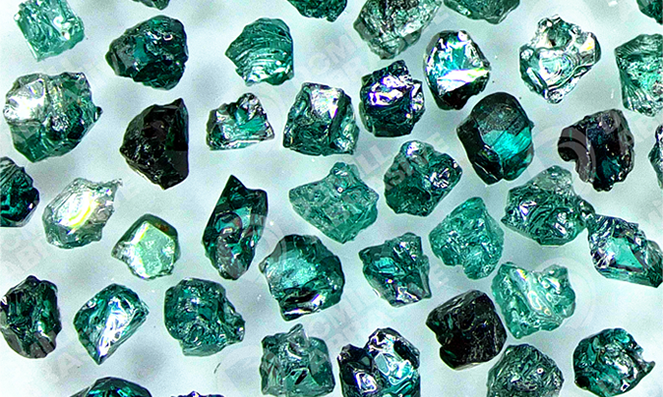
DOMILL Green Silicon Carbide (designated as GC) is synthesized via the Acheson electric resistance furnace process at extreme temperatures of 2300 °C using ultra-high-purity petroleum coke and quartz sand, with sodium chloride (NaCl) added as a refining agent to remove iron impurities.
The dominant crystal phase is translucent hexagonal α-SiC, delivering an exceptionally high SiC purity of ≥ 99.0%.
Physically and chemically, Green SiC exhibits a Mohs hardness of 9.4–9.5 and a Vickers hardness of HV 3200–3400, standing directly beneath diamond and CBN. It features supreme crystal friability, sharp micro-cleavage self-sharpening kinetics, a high thermal conductivity of 100–140 W/(m·K), and strictly controlled free iron content (Free Fe ≤ 0.05%). DOMILL categorizes Green SiC into two specialized grades: GC18 engineered for vitrified/resinoid bonded abrasive tools and pressure blasting, and GC25 tailored for high-precision coated abrasives, micro-blasting, and non-woven wheel manufacturing. (Note: Due to high-temperature chemical affinity, Green SiC is strictly contraindicated for processing ferrous metals).
| Grade Code | Primary Target | Grain Standards | Key Physical & Morphological Traits |
|---|---|---|---|
| GC18 | Bonded Abrasives & Pressure Blasting | FEPA F (F12–F1200), JIS (60#–3000#), ISO / ANSI | High isometric grain proportion with extreme hardness and rapid heat dissipation; designed for vitrified/resinoid grinding wheels and heavy-duty pressure blasting. |
| GC25 | Coated & Precision Micro-Blasting | FEPA P (P12–P2500), JIS / ANSI / Custom | High aspect ratio with sharp micro-cleavage edges; optimized for electrostatic belt coating, precision micro-blasting, and non-woven abrasives. |
Near-Diamond Hardness & Sharp Friability: Features a Vickers hardness of HV 3200–3400 (Mohs 9.4–9.5). High friability allows continuous micro-spalling along cleavage planes under shear stress, maintaining low normal grinding force.
High Thermal Conductivity (100–140 W/(m·K)): High thermal conductivity of 100–140 W/(m·K) enables rapid dissipation of localized friction heat during grinding, preventing workpiece thermal burns and micro-cracks.
Free Fe ≤ 0.05% & Zero Oversize Particle Hazard: Salt-refined process keeps Free Fe ≤ 0.05%. Closed-loop classification restricts D100 oversize grains, guaranteeing scratch-free surfaces on coated belts and micro-blasted workpieces.
DOMILL Green SiC Architecture
├── GC18 (Bonded Abrasives & Pressure Blasting)
│ ├── Vitrified/Resinoid Wheels for Tungsten Carbide, Titanium Alloys, Gemstones, Glass & Ceramics
│ └── Pressure Blasting for Carbide Components, Deburring, Surface Roughing & Anti-Skid
└── GC25 (Coated Abrasives & Precision Micro-Blasting)
├── Precision Coated Abrasives: Carbide/Titanium Finishing Sanding Belts & Papers
└── Precision Micro-Blasting: Glass Etching, PCB Hole Cleaning & Non-Woven Wheels
1. Bonded Abrasives – GC18: Formulated into vitrified and resinoid wheels for precision sharpening of tungsten carbide tooling, end mills, inserts, and titanium alloy components without thermal damage. Extensively utilized in grinding wheels and blocks for processing optical glass, gemstones, quartz, and technical ceramic components.
2. Coated & Non-Woven Abrasives – GC25: Delivers superior electrostatic vertical grain alignment in sanding belts and papers for surface finishing and fine polishing of cemented carbides. Integrated into green SiC non-woven polishing wheels and flap discs for uniform finish under low pressure.
3. Blasting & Surface Preparation – GC18 / GC25: Used in high-pressure blasting equipment to deburr and roughen tungsten carbide components and technical ceramics with long service life. Micro-powders engineered for optical glass etching, PCB hole cleaning, and non-contaminating micro-blasting of semiconductor fixtures.
| Property | Typical Value |
|---|---|
| Crystal Phase | α-SiC (Translucent Hexagonal) |
| SiC Content | ≥ 99.0% |
| Synthesis & Refining | Acheson Process (2300 °C) + NaCl Refining |
| Mohs Hardness | 9.4 – 9.5 (Second only to Diamond/CBN) |
| Vickers Hardness | HV 3200 – 3400 |
| Thermal Conductivity | 100 – 140 W/(m·K) |
| Free Fe | ≤ 0.05% |
| Substrate Contraindication | Ferrous Metals (Due to high-temp affinity) |
| Optional Standards | FEPA (F/P), JIS, ISO, ANSI |
A: At elevated grinding temperatures (> 800 °C), high-purity Green SiC exhibits strong chemical affinity toward iron (Fe). Carbon atoms within the SiC lattice rapidly dissolve into the ferrous matrix, causing severe chemical wear and instant grain dulling. For ferrous metals and grey iron, Black SiC (C Series) or Fused Alumina should be selected; Green SiC is strictly reserved for non-ferrous substrates like tungsten carbide, titanium alloys, glass, and technical ceramics.
Q: What is the technical distinction between DOMILL GC18 and GC25 grades?
A: GC18 (Bonded & Pressure Blasting): Optimized for isometric grain shape and structural strength. Built to withstand high wheel compaction pressure and high-velocity sandblasting impact while maintaining rapid thermal dissipation.
GC25 (Coated & Precision Micro-Blasting): Shape-tailored for a high aspect ratio and sharp fracture points. Ensures precise vertical orientation during electrostatic belt coating and eliminates rogue oversized grains during micro-blasting.
Please fill out the form.We will reply you in 24 hours.