Home / Products / Blasting Media / High-Carbon Steel Shot
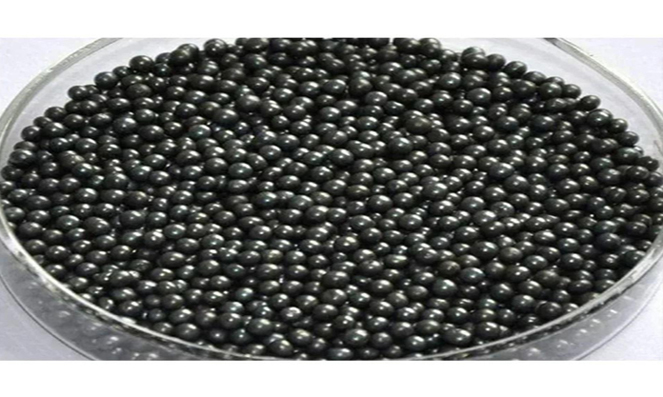
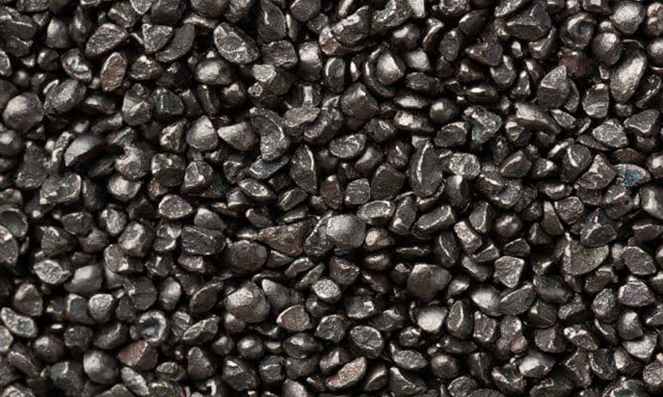
DOMILL High-Carbon Steel Shot is manufactured from high-purity electric-arc furnace molten steel, refined and atomized into dense spherical droplets, followed by specialized double-quenching and tempering heat treatments.
The resulting shot features a uniform tempered martensite microstructure, optimized hardness (standard 45–52 HRC / 400–500 HV), and exceptional impact fatigue durability.
Engineered specifically for automated wheel blast machines (roller conveyor, tumble, and hook-type blast equipment), high-carbon steel shot delivers massive kinetic energy upon impact to shatter foundry mold sand, heavy forging scale, and welding slag. Its smooth spherical shape minimizes frictional abrasive wear on blast wheel blades, control cages, and housing liners. Furthermore, in Shot Peening operations for automotive springs, gears, crankshafts, and aerospace components, DOMILL steel shot induces beneficial compressive residual stresses to dramatically boost fatigue resistance.
( Substrate Compatibility Warning: Steel shot is a ferrous media and is strictly prohibited on aluminum alloys, stainless steel, titanium, and medical components. Embedded iron particles induce severe galvanic corrosion and yellow rust staining. For non-ferrous or stainless steel applications, mandatory upgrade to DOMILL White Fused Alumina (Al2O3≥99%) or DOMILL Glass Beads is required.)
Severe Blast Wheel Blade Wear from Angular Media: Using sharp angular media like fused alumina or garnet in wheel blast systems severely erodes blast wheel blades and impellers. Spherical steel shot reduces friction, multiplying blade service life and slashing maintenance downtime.
Slow Sand & Mill Scale Stripping on Castings & Forgings: Burned-in foundry sand and thick heat-treat scale resist lightweight media. High-carbon steel shot features high specific gravity (≥7.4 g/cm3), transmitting maximum kinetic energy to shatter heavy contaminants instantly.
Fatigue Failure & Precise Peening Profile Control: Cyclic loading induces premature fatigue failure in automotive springs and gears. DOMILL’s high-sphericity shot establishes a uniform compressive stress layer without inducing micro-fissures or stress raisers.
3.1 Physical & Chemical Specifications Table
|
Classification |
Property / Element |
Control Specification / Typical Value |
Technical Context & Guidance |
|
Physical Spec |
Particle Shape |
Atomized Spheroidal / Round |
Minimizes blast wheel component friction and erosion |
|
|
Specific Gravity |
≥7.4 g/cm3 |
High density yields maximum kinetic energy transfer |
|
|
Bulk Density |
≥4.4 g/cm3 |
Calibrated for automated blast hopper volume control |
|
|
Hardness Range |
Standard: 45 – 52 HRC (400–500 HV) Special: 52 – 60 HRC (Peening Special) |
Standard grade balances cleaning speed and blade protection |
|
|
Microstructure |
Fine Tempered Martensite / Troostite |
Homogeneous density with zero shrinkage voids; >2000 cycles |
|
|
Defect Limit |
Elongated <10%, Hollow <3% |
High sphericity ensures uniform residual stress layer |
|
Chemical Analysis |
Carbon (C) |
0.80% – 1.20% |
High carbon alloy ensuring hardness and elastic rebound |
|
|
Silicon (Si) |
0.40% – 1.20% |
Deoxidizer enhancing lattice strength |
|
|
Manganese (Mn) |
0.60% – 1.20% |
Enhances hardenability and toughness |
|
|
Sulfur (S) |
≤0.05% |
Strictly limited to eliminate hot shortness and cracking |
|
|
Phosphorus (P) |
≤0.05% |
Strictly limited to preserve high impact toughness |
|
SAE Grade |
Nominal Size |
Screen Range |
Primary Application |
Blast Performance & Benefit |
|
S-780 |
2.00 mm |
1.70 – 2.40 mm |
Extra heavy steel castings, heavy forgings, thick scale |
Maximum kinetic impact for shattering burnt-in sand on heavy parts |
|
S-660 |
1.70 mm |
1.40 – 2.00 mm |
Large iron castings, structural steel descaling |
High mass momentum delivering rapid primary descaling |
|
S-550 |
1.40 mm |
1.18 – 1.70 mm |
Medium-large castings, large steel pipes, shipyard plates |
Excellent balance between high stripping speed and coverage density |
|
S-460 |
1.20 mm |
1.00 – 1.40 mm |
Standard Workhorse Grade; steel sectionals, forgings |
Industry workhorse size; optimal mix of speed and coverage |
|
S-390 |
1.00 mm |
0.85 – 1.18 mm |
Small-medium castings, pipe walls, heat-treated parts |
High impression density; yields a smooth, uniform surface profile |
|
S-330 |
0.80 mm |
0.71 – 1.00 mm |
Automotive hardware, small castings, sheet metal prep |
Moderate anchor pattern depth; reduces paint fill consumption |
|
S-280 |
0.70 mm |
0.60 – 0.85 mm |
Automotive Shot Peening, precision forgings |
Benchmark for gear and spring peening; induces deep stress layer |
|
S-230 |
0.60 mm |
0.50 – 0.71 mm |
Precision coil spring peening, small gears, hardware |
High particle count per kg; builds high residual compressive stress |
|
S-170 / S-110 |
0.40 / 0.30 mm |
0.18 – 0.50 mm |
Ultra-precision peening, delicate deburring, tools |
Maximum hit density for pristine, smooth peening profile |
|
Operating Condition & Application |
Recommended Abrasive |
Selection Rationale & Upgrade Benefit |
Cost & Efficiency Impact |
|
Ferrous Casting Descaling & Wheel Blast Peening |
DOMILL High-Carbon Steel Shot |
Dedicated Wheel Blast Media; spherical shape protects blades; high density (≥7.4 g/cm3); 2000+ cycles |
Lowest operating cost per ton in automated conveyor wheel blast lines |
|
Heavy Anti-Corrosion / Angular Anchor Profile |
Upgrade to DOMILL High-Carbon Steel Grit |
Morphology Jump (Angular vs Spherical); sharp grit micro-machines metal to produce aggressive, deep anchor profiles |
Delivers maximum mechanical adhesion for high-build protective coatings |
|
Non-Ferrous (Aluminum / Stainless) Surface Prep |
Upgrade to DOMILL White Fused Alumina / Glass Beads |
Non-Ferrous Material Jump; 100% Zero Iron Contamination (Steel shot embeds into aluminum causing severe galvanic rusting) |
Mandatory for stainless steel, aluminum castings, and medical components |
|
Pneumatic Air Blasting Guns / Manual Blast Rooms |
Upgrade to DOMILL Brown Fused Alumina (BFA) |
Equipment Suitability Jump; steel shot is too heavy for standard air guns. BFA (Mohs 9.0) flows easily with high cutting speed |
Ultimate versatile choice for suction/pressure pneumatic air-blast cabinets |
1. Foundry Sand Removal & Forging Descaling: Widely utilized in tumble and conveyor blast machines to remove burned-in core sand from iron castings and scale from heat-treated forgings.
2. Automotive & Aerospace Shot Peening: Benchmark peening media for automotive coil springs, leaf springs, transmission gears, and crankshafts to build compressive residual stress layers.
3. Steel Plate & Sectional Wheel Blast Lines: Used in roller-conveyor blast lines to descale structural H-beams and marine steel plates prior to shop primer application.
4. Working Mix: Blended with DOMILL Steel Grit to establish a stable operating "Working Mix", balancing fast cutting action with reduced machinery wear.
Q: What is the fundamental difference between Steel Shot and Steel Grit, and how should they be chosen for a wheel blast machine?
A:
1. Shape & Action: Steel Shot is spherical, using impact force to shatter scale while preserving blast wheel blades. Steel Grit is sharp and angular, micro-machining the steel to etch an aggressive anchor profile.
2. Selection: For general sand removal, shot peening, and lowest equipment maintenance, choose Steel Shot. For high-build anti-corrosion coating prep requiring deep angular roughness, choose Steel Grit. A blended Working Mix is often optimal.
Q: Why is high-carbon steel shot strictly prohibited on aluminum alloy castings, and what is the proper replacement?
A: High-carbon steel shot is a ferrous material. Upon high-velocity impact against softer aluminum, microscopic steel particles embed into the aluminum matrix. When exposed to humidity, these trapped iron particles set up localized galvanic cells, triggering severe galvanic corrosion and ugly yellow rust spots. Aluminum surface prep mandatorily requires DOMILL White Fused Alumina (100% Iron-Free) or DOMILL Glass Beads.
Q: What is a "Working Mix" in wheel blast operations, and why is it more efficient than using fresh single-sized steel shot?
A: An optimized "Working Mix" inside a blast machine consists of a dynamic equilibrium of large new shots, medium worn shots, and fine operating particles. Large shots provide kinetic impact to shatter heavy scale, while smaller worn particles fill coverage gaps to maximize blast hit density. Adding a 20% blend of DOMILL Steel Grit into the steel shot mix dramatically increases surface stripping rates while maintaining blast wheel protection.
Please fill out the form.We will reply you in 24 hours.