Home / Products / Blasting Media / High-Carbon Steel Grit
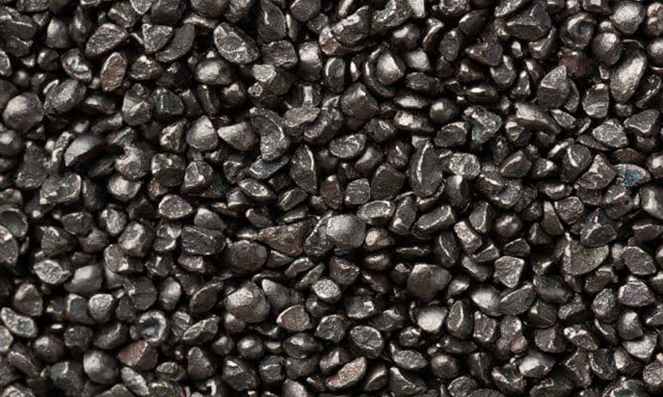
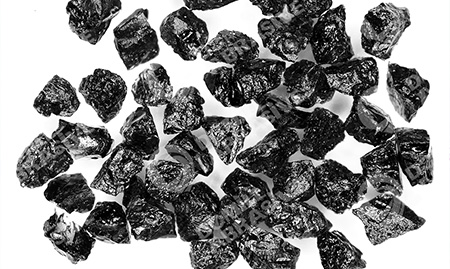
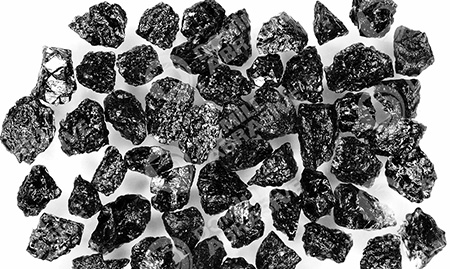
DOMILL High-Carbon Steel Grit is manufactured by mechanically crushing oversized high-carbon steel shots into angular, sharp-edged particles, followed by specialized double-quenching and tempering heat treatments.
|
Classification |
Property / Element |
Control Specification / Typical Value |
Technical Context & Guidance |
|
Physical Spec |
Particle Shape |
Crushed Angular / Multi-Faceted |
Sharp facets provide aggressive micro-machining & etching |
|
|
Specific Gravity |
≥7.4 g/cm3 |
High density transmits maximum kinetic impact energy |
|
|
Bulk Density |
≥4.4 g/cm3 |
Calibrated for blast room hopper pressure metering valves |
|
|
Hardness Class (Hardness Grades) |
GP Class: 40 – 50 HRC (400–500 HV) GB Class: 50 – 56 HRC (510–610 HV) GH Class: 60 – 66 HRC (700–850 HV) |
GP: Rounds up during blast wheel use to protect blades; GB: Versatile, retains angularity longer in wheel/air systems; GH: Pneumatic room special; stays sharp forever for max speed |
|
|
Microstructure |
Homogeneous Tempered Martensite |
High structural integrity with zero voiding; long cycle life |
|
Chemical Analysis |
Carbon (C) |
0.80% – 1.20% |
High carbon content ensuring maximum hardness and elastic bounce |
|
|
Silicon (Si) |
0.40% – 1.20% |
Lattice-strengthening deoxidizer |
|
|
Manganese (Mn) |
0.60% – 1.20% |
Improves hardenability and fracture toughness |
|
|
Sulfur (S) |
≤0.05% |
Strictly limited to eliminate hot shortness and cracking |
|
|
Phosphorus (P) |
≤0.05% |
Strictly limited to preserve high impact resistance |
4.1 SAE Standard Specifications & Applications Table
|
SAE Grade |
Nominal Size |
Screen Range |
Primary Application |
Anchor Profile & Blast Performance |
|
G-10 (G-120) |
2.40 mm |
2.00 – 2.80 mm |
Granite stone gang-saw cutting, extra heavy castings |
Maximum penetration depth for thick elastomeric linings |
|
G-12 (G-100) |
2.00 mm |
1.70 – 2.40 mm |
Heavy structural steel, ship hulls, tank bottom plates |
Etches deep anchor profile (>100 \mum) for ultra-thick epoxies |
|
G-14 (G-80) |
1.70 mm |
1.40 – 2.00 mm |
Heavy bridge girders, marine blast room pre-treatment |
Rapid stripping speed; creates 85–110 μm angular profile |
|
G-16 (G-60) |
1.40 mm |
1.18 – 1.70 mm |
Shipyards, oil & gas cross-country pipes, containers |
Optimal balance of speed & coverage; builds 75–100 μm pattern |
|
G-18 (G-50) |
1.20 mm |
1.00 – 1.40 mm |
Workhorse Grade for Heavy Blasting; pipe walls |
Industry workhorse size; yields 65–85 μm profile depth |
|
G-25 (G-40) |
1.00 mm |
0.71 – 1.18 mm |
Steel pipe descaling, general industrial painting prep |
Creates 55–75 μm fine profile with exceptional hit density |
|
G-40 (G-25) |
0.70 mm |
0.425 – 0.85 mm |
Auto parts, sheet metal descaling, structural prep |
Produces 40–60 μm uniform profile, saving topcoat paint fill |
|
G-50 (G-18) |
0.40 mm |
0.30 – 0.60 mm |
Deburring precision gears, inner pipe walls, roll etching |
High hit density; produces fine, homogenous micro-etching |
|
G-80 / G-120 |
0.30 / 0.20 mm |
0.125 – 0.425 mm |
Precision mold cleaning, delicate deburring, tool prep |
Ultra-fine homogenous etching without substrate distortion |
Aggressive Etching for Maximum Coating Keyway: Crushed angular facets micro-machine the substrate to etch deep 50–120 μm keyways, maximizing mechanical bonding for high-build anticorrosive coatings.
Three Customized Hardness Classifications: GP grade rounds up in wheel systems to spare blades; GB provides versatile balance; GH grade (≥60 HRC) stays permanently sharp in pneumatic rooms for maximum stripping speed.
High Mass Density & Recycling Reusability: Specific gravity of ≥7.4 g/cm3 delivers massive kinetic impact. Tough martensitic microstructure ensures long fatigue life in enclosed recovery blast rooms.
|
Operating Condition & Application |
Recommended Abrasive |
Selection Rationale & Upgrade Benefit |
Cost & Efficiency Impact |
|
Ferrous Heavy Steel Prep / Heavy Anti-Corrosion |
DOMILL High-Carbon Steel Grit |
Heavy Coating Keyway Media; high density (≥7.4 g/cm3); GH grade stays sharp for deep 50–120 μm angular anchor patterns |
Maximum paint adhesion; long recycle life in enclosed recovery blast rooms |
|
Non-Ferrous (Aluminum / Stainless Steel) Prep |
Upgrade to DOMILL White Fused Alumina (WFA) |
Non-Ferrous Material Jump; 100% Zero Iron Contamination (Steel grit embeds into aluminum causing severe galvanic rust spots) |
Mandatory for stainless steel, aluminum castings, and aerospace alloys |
|
Manual Air Guns / Paint Fill Saving / Max Cutting |
Upgrade to DOMILL Brown Fused Alumina (BFA) |
Hardness & Versatility Jump (Mohs 9.0 vs 7.5); steel grit is too heavy for small air guns; BFA yields extremely uniform profile |
Prevents paint fill waste from over-deep steel pits; ultimate pneumatic choice |
|
Automated Wheel Blast Descaling (Blade Protection) |
Select DOMILL Steel Shot or Shot+Grit Working Mix |
Equipment Protection; pure GH steel grit rapidly destroys blast blades. Use Steel Shot or a 80% Shot + 20% GP Grit Working Mix |
Balances fast stripping capability with minimal blast wheel component wear |
Q: How do I choose between GP, GB, and GH hardness classifications for my specific blast setup?
A: Each grade targets specific machinery and etching needs:
1. GP Grade (40–50 HRC): Lowest hardness; angular edges round up during blast wheel impact. Designed for Wheel Blast Machines to descale while preserving blast blades;
2. GB Grade (50–56 HRC): Medium hardness; retains angular shape longer. Ideal for heavy wheel blast lines or large air blast rooms requiring balanced cutting and blade life;
3. GH Grade (60–66 HRC): Maximum hardness; stays permanently sharp and never rounds up, delivering maximum cutting speed. Exclusively for Pneumatic Blast Rooms. Warning: Never run pure GH grit in a wheel blast machine, as it will rapidly destroy blast wheel blades!
Q: Why is steel grit strictly forbidden on stainless steel and aluminum, and what is the optimal alternative?
A: Steel grit is a ferrous abrasive. Upon high-velocity impact against soft aluminum or stainless steel, microscopic iron particles embed into the substrate surface. Exposed to ambient humidity, these trapped iron fragments set up localized galvanic cells, triggering rapid galvanic corrosion and ugly yellow rust spots. Stainless steel and aluminum prep mandatorily requires DOMILL White Fused Alumina (Al2O3≥99%, 100% Iron-Free).
Q: What are the main limitations of Steel Grit compared to Brown Fused Alumina in manual pneumatic blast rooms?
A: In handheld or small suction blast systems, Brown Fused Alumina (BFA) offers distinct operational edges:
1. Pneumatic Flowability: Steel grit’s heavy density (7.4 g/cm3) causes line clogging in standard air guns due to insufficient lifting power. BFA (~3.9 g/cm3) flows effortlessly;
2. Hardness & Speed: BFA features a Mohs hardness of 9.0 (significantly harder than steel grit's Mohs 7.5), shearing off tough scale faster;
3. Paint Consumption Efficiency: Coarse steel grit creates over-deep pits requiring excessive primer paint to fill flat. BFA generates a homogenous micro-etched anchor pattern that optimizes paint coverage.
Please fill out the form.We will reply you in 24 hours.