Home / Products / Treated & Calcined Brown Fused Alumina (BFA) / ABR: Two-Stage High-Toughness Coated BFA
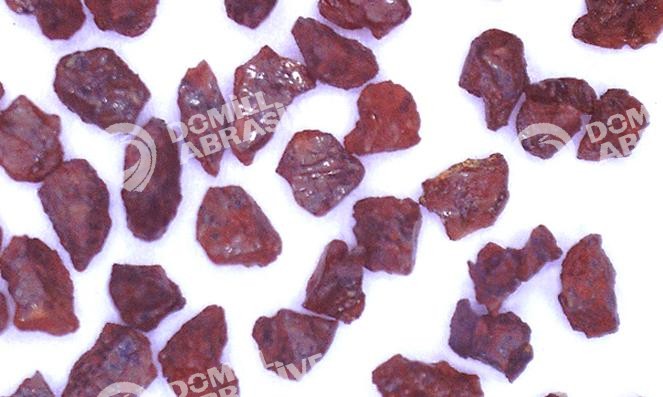
The DOMILL ABR: Two-Stage High-Toughness Coated Brown Fused Alumina series represents the absolute zenith of thermal modification and surface encapsulation engineering.
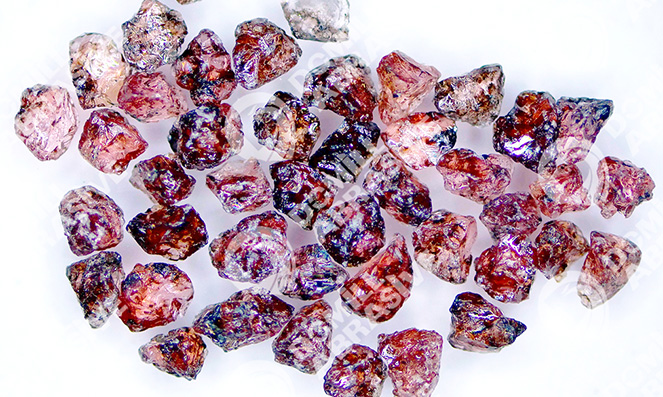
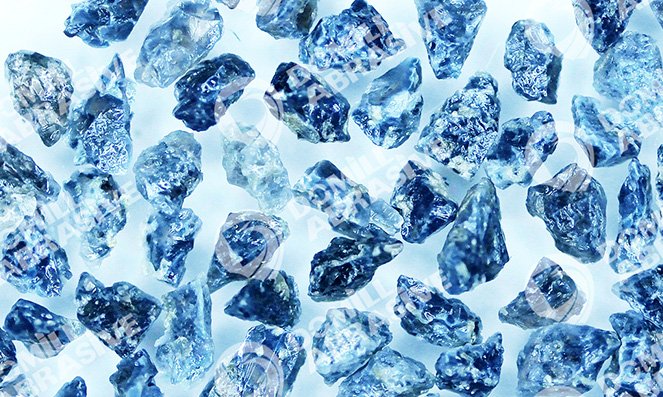
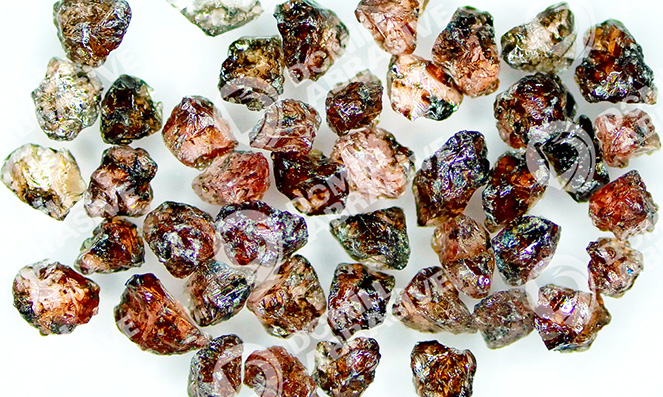
Characterized by its unique "blue-core, red-coat" structure, this flagship grade integrates 1350°C extreme recrystallization (blue firing) with 1050°C high-temperature ceramic-melt glaze coating (red coating) into a dual-stage thermal sequence. In the first stage, premium BFA undergoes deep thermal soaking at 1350°C to induce complete recrystallization of the α-alumina crystal matrix, relieving all internal stresses and stabilizing an ultra-tough "Blue BFA" core. In the second stage, the recrystallized core is encapsulated with a proprietary nano-scale, high-affinity red ceramic slurry and sintered a second time at temperatures exceeding 1050°C. This creates a highly rugged, micro-porous vitrified glass-ceramic anchor that is molecularly fused to the tough core.
The ABR series is custom-engineered for the most severe stress, heavy-duty grinding environments in advanced industrial manufacturing. The dual-stage high-temperature recrystallization yields a massive 35% to 50% surge in single-grain compressive toughness (L75 index), preventing erratic grain fragmentation under heavy loads. Simultaneously, the surface glass-ceramic glaze drives capillary hydrophilicity to its physical limit (over 95 mm rise), allowing liquid resins or vitrified glazes to wet the grains at a molecular level within microseconds, creating a void-free chemical crosslink network. Whether operating in robotic grinding lines under high pressure or sustaining extreme tensile stresses in automated wide belts, the ABR series secures continuous cutting without premature loading or shedding, serving as the technical catalyst for next-generation abrasive tools.
In automated heavy-duty snagging, robotic weld-seam dressing, and high-tension wide-belt dry polishing of titanium and superalloys, generic or single-treated abrasives collapse under the combined actions of extreme mechanical shear and soaring interfacial temperatures. The DOMILL ABR series is engineered to prevent and eliminate the following critical systemic failure risks:
Shattering & Rupture Under Heavy Robotic Snagging: During automated robotic snagging, grinding wheels sustain continuous radial hydraulic loads of hundreds of kilograms. Any micro-defect in the abrasive core leads to sudden explosive pulverization upon contact with the workpiece, destroying active cutting edges and causing a catastrophic collapse in wheel service life.
Severe Interfacial Shear & Coating Delamination: In high-tension wide-belt grinding, intense shear stresses act on the boundary interface. Conventional low-to-medium-temperature coatings often suffer from "interfacial peeling" under high pressure—where the coating delaminates from the grain core, causing rapid shedding.
Frictional Heat Graded Degradation & Binder Carbonization: In high-speed dry grinding of superalloys, the contact temperature easily spikes above 1300°C. Lacking an ultra-high temperature barrier, standard abrasives conduct this heat directly to the underlying phenolic resin, causing rapid binder carbonization, black burn spots, and large-scale grain loss.
Technical Context: Because the dual-stage high-temperature sequence eliminates all native phase transformations and Loss on Ignition (LOI), its mineral phase and chemical stability are highly secured. For precise standard reference, the physical and chemical specifications of the ABR series are benchmarked against FEPA F36 / P36 grit size.
| Property | Specification Matrix | Technical Context & Guidance |
|---|---|---|
| Al₂O₃ Content | 93.2%–94.5% | Dual high-temperature sintering maximizes core purity, wrapped in 1.2%–1.8% of high-fired micro-crystalline glaze. |
| TiO₂ Content | 1.5%–2.8% | Titanium ions are fully dissolved at 1350°C to form an ultra-stable deep blue-black core, eliminating micro-segregation. |
| Fe₂O₃ Content | < 0.05% | Extremely suppressed iron residue via double-stage thermal oxidation and secondary magnetic purging. |
| SiO₂ Content | 1.2%–2.2% | Includes silicon phases from the high-temp red glaze, fusing an inorganic network on the grain surface. |
| Coating Type | Two-Stage High-Temp Ceramic Red Glaze | Co-sintered glaze fired at >1050°C, establishing molecular-level covalent bonding with the BFA core. |
| Toughness Increment | +35%–50% | Represents the physical ceiling of BFA toughness. Fully healed lattice defects yield highly controlled micro-fracturing. |
| Hydrophilicity Height | ≥ 95 mm / 10min | Peak capillary hydrophilicity. Assures 100% coverage and void-free mechanical interlocking with binders. |
| Magnetic Content | ≤ 0.0008% | Ultra-pure index. Minimizes chemical voids, ensuring maximum burst safety for high-stress tools. |
| Sizes Available | FEPA F8–F220 / P8–P220 | Full size range across F-grits and P-grits; high-density blocky shapes available for premium performance. |
| Particle Size Standard | FEPA Standard 42 / GB/T 2481 | Fully compliant; JIS or ANSI sizing specifications are available upon request. |
Recrystallized "Blue Corundum" Core & Peak Integrity: The initial 1350°C extreme thermal sequence induces microstructural recrystallization within the corundum lattice, driving crystal density to its physical peak. This completely eradicates stress fractures while raising single-grain compressive toughness (L75) by 35% to 50%. ABR grains maintain superb integrity under extreme hydraulic loads on hard alloys, preventing early structural failure.
Vitrified Ceramic Glaze & Covalent Anti-Peeling Interface: Unlike standard coated abrasives, ABR's secondary coating is sintered at high temperatures (>1050°C). Active components in the red glaze partially inter-diffuse with aluminum and oxygen atoms on the recrystallized BFA core, creating a molecular-level covalent link. The glaze becomes part of the grain, fully eliminating coating delamination under heavy lateral shear.
95 mm Peak Capillary Wetting & Thermal-Insulating Lock: Double-stage thermal oxidation drives the capillary wetting height to a premium 95 mm or higher. Binders wet the micro-rough topography seamlessly without leaving tiny air gaps, multiplying bonding strength. Furthermore, the high-fired glass-ceramic layer serves as a micro-thermal barrier, insulating the binder from friction heat and preventing premature degradation.
1. Robotic Heavy-Duty Snagging & High-Pressure Wheels: Deployed for automated robotic grinding stations across automotive, aerospace, and metallurgy lines. ABR's extreme toughness and covalent glaze bond withstand constant hydraulic pressures. It delivers continuous self-sharpening without premature fragmentation during high-rate removal of casting gates, forging flashes, and railway tracks.
2. Flagship Automated Wide Belts & Vulcanized Fiber Discs: Specifically formulated for premium, automated wide belts and vulcanized fiber discs used to polish cold-rolled stainless sheets, titanium plates, and turbine blades. The highly aligned electrostatic polarization, coupled with ABR's void-free wetting, secures unbreakable cohesion with backings under massive tensile stress and dry-grinding heats, pushing the grinding G-ratio to the industrial ceiling.
3. Superalloy Vitrified Segmental Wheels: Engineered for premium vitrified segmental wheels grinding nickel-based superalloys, single-crystal alloys, and critical structural parts. Its ultra-low iron and magnetic index (≤ 0.0008%) coupled with exceptional thermal volume permanence and glaze co-sintering affinity secure minimal sintering shrinkage, zero porosity defects, and flawless finishing results.
The ABR series is the performance crown of DOMILL's modified BFA line. For technical-economic optimization, align applications according to these boundaries:
(For precision vitrified internal grinding or medium-load bonded tools where shear forces are moderate: Choose the AT: 1050 Calcined Brown Fused Alumina to cost-effectively eliminate microscopic crystal stress.)
(If operating heavy mechanical snagging or dry rail cutting where physical grain packing dominates and interfacial peeling is a minor concern: Specify the recrystallized AB: 1350 Calcined Brown Fused Alumina to harness peak structural toughness.)
(For general resinoid cutting wheels or flap discs suffering from premature whole-grain pull-out under standard operational pressures: Transition to the ATR: Standard Ceramic Coated BFA to utilize its highly cost-competitive capillary anchoring properties.)
Q: Why is the ABR series commonly referred to as the "blue-core, red-coat" double-treated abrasive? What is the technical leap of this dual-stage process (1350°C + 1050°C) over conventional single-stage coating?
A: Standard ceramic-coated abrasives (like the ATR series) are typically made by coating raw BFA grains and sintering them once at 800°C to 1050°C. While this successfully elevates surface wetting, the brief single heating cannot induce deep recrystallization to fully repair internal lattice fractures inherited from harsh mechanical crushing. Thus, the physical grain toughness remains limited, failing under extreme robotic snagging pressures.
DOMILL's ABR flagship series completely reshapes this thermodynamics: Stage one subjects the raw grains to prolonged pre-calcination at an extreme 1350°C. At this temperature, titanium ions fully diffuse into the alumina lattice, inducing microstructural recrystallization and healing all internal shear fractures, turning the core deep blue-black (producing the ultimate tough "blue core"). Stage two wraps this blue core with nano-scale red ceramic glaze and sinters it a second time at temperatures exceeding 1050°C. At this high thermal threshold, the molten silica-alumina glaze phase chemically reacts and co-crystallizes with the surface atoms of the recrystallized core, establishing a covalent molecular bridge upon cooling (creating the permanent "red coat"). This dual-stage "blue-core, red-coat" sequence yields a generational leap in compressive toughness (up 35% to 50%) while securing absolute covalent adhesion. Under intense dry-grinding friction and immense force, the coating never delaminates, the binder never shears, and the crystal core never shatters.
Q: Will the red ceramic glaze of the ABR series decompose or degrade the wheel structure during the high-temperature sintering of Vitrified Wheels?
A: Absolutely not. The red glaze on ABR grains is a highly stabilized inorganic micro-crystalline glass phase co-sintered at temperatures exceeding 1050°C. It contains zero organic binders or low-temperature volatile compounds (Loss on Ignition is virtually zero). During the typical 900°C–1050°C sintering sequence of vitrified wheels, this inorganic glaze remains perfectly stable while chemically inter-diffusing with the liquid glass phase of the vitrified bond. This acts as a molecular bridge between the bond and the corundum core, neutralizing localized thermal stresses and boosting the structural burst speed of the vitrified wheel.
Please fill out the form.We will reply you in 24 hours.