Home / Products / Treated & Calcined Brown Fused Alumina (BFA) / ATR: Ceramic Coated Brown Fused Alumina
The DOMILL ATR: Standard Ceramic Coated Brown Fused Alumina series is a surface-engineered abrasive specifically developed to resolve the systemic issue of premature grain pull-out in resin-bonded systems.
By uniformly coating the BFA grains with a proprietary formulation of nano-scale mineral ceramic slurry and subsequently sintering the matrix in a controlled medium-temperature rotary kiln (800°C~1050°C), a highly rugged, micro-porous ceramic red glaze is fused onto each grain. This dual-action process radically alters the surface chemistry of the grain---shifting BFA from its native hydrophobic state to an ultra-hydrophilic, capillary-active topography. The ATR series establishes an unbreakable mechanical anchor and chemical crosslink with phenolic resin networks inside high-speed resinoid cutting wheels, flap discs, and industrial belts.
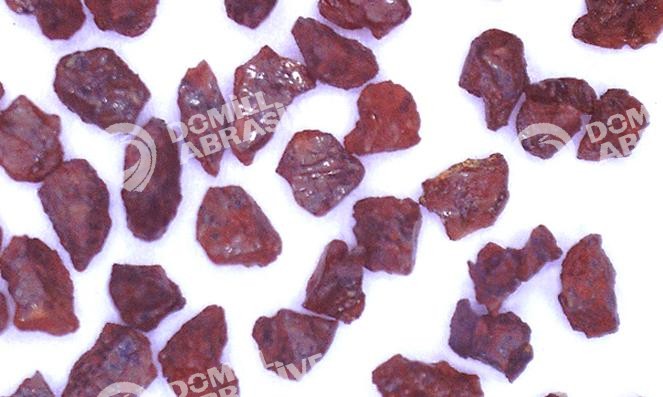
Benefiting from this micro-crystalline ceramic layer (featuring a distinctive brick-red hue, commercially known as "Ceramic Red Coating"), the ATR grains achieve 100% wet-out of liquid phenolic resins through intense capillary mechanics. Furthermore, the medium-temperature calcination inherent in the coating process delivers supplementary stress-relief benefits, mildly reinforcing the crystal matrix's fracture resistance. When subjected to intense rotational shear and grinding friction, the ATR series firmly resists premature grain shedding, ensuring a highly coordinated micro-fracturing self-sharpening cycle. This serves as an industrial-grade catalyst for coated and bonded abrasive manufacturers to elevate overall tool lifespan and cutting rates by 30%~50%.
In high-speed grinding, weld-seam finishing, flap-disc processing, and high-tension belt sanding, the physical-chemical incompatibility at the resin-mineral interface is the root cause of premature tool failure. The DOMILL ATR series deploys an inorganic ceramic transition layer to structurally prevent and eliminate the following vulnerabilities:
Capillary Incompatibility & Premature Grain Shedding: Untreated BFA surfaces are smooth and hydrophobic, yielding poor affinity to high-viscosity phenolic resins. Under grinding drag forces, the resin easily delaminates from the grains, pulling out active crystals prematurely and resulting in catastrophic bald spots on sanding belts and grinding discs.
Frictional Heat Accumulation & Interfacial Carbonization: During dry sanding or weld-seam dressing without coolant, friction heat spikes rapidly. Lacking an inorganic transition barrier, the thermal wave degrades the organic resin binder directly, causing localized carbonization and interfacial cracking, which triggers large clusters of grains to peel off with the degraded binder.
Tumbling Grains & Erratic Electrostatic Deposition: Inside high-voltage electrostatic sand-coating chambers, untreated P-grits often suffer erratic charge distributions, causing grains to lie flat or embed horizontally. This exposes blunt edges rather than sharp tips. The ceramic coating provides uniform surface polarizability, eliminating tumbling defects.
Technical Context: Due to the integration of the surface ceramic glaze, the chemical composition of the coated series includes inorganic oxides from the coating formulation. For precise standardization, DOMILL benchmarks the physical and chemical specifications of the ATR series using FEPA F36/P36 grit size as the baseline.
|
Property |
Specification Matrix |
Technical Context & Guidance |
|
Al2O3 Content |
93.8%–95.0% |
Contains trace sintered ceramic coating matrix (approx. 0.5%–1.2% inorganic Fe-Si-Al red glaze), fractionally lowering the total alumina percentage without compromising core hardness. |
|
TiO2 Content |
1.8%–3.2% |
Inherent titanium oxide phase within the BFA crystal lattice, partially oxidized during medium-temperature sintering to secure micro-toughness. |
|
SiO2 Content |
1.0%–1.8% |
Includes silica from the coating binder phase, engineered to form a micro-crystalline network on the grain surface during sintering. |
|
Coating Type |
Ceramic Red Glaze (Medium-Temp) |
Proprietary medium-temperature micro-crystalline ceramic red glaze. Features a micro-porous, high-friction surface topography. |
|
Hydrophilicity Height |
≥85 mm / 10min |
Surface energy scales exponentially (3-to-4-fold increase over untreated grains), securing 100% wet-out and absorption of liquid resins. |
|
Toughness Increment |
10%–20% |
The BFA core undergoes simultaneous 800°C–1050°C thermal healing, resulting in moderate lattice optimization and higher compressive strength. |
|
Magnetic Content |
≤0.0050% |
Strictly controlled free-iron residue to prevent thermal staining or contamination on delicate alloys and stainless steel. |
|
Sizes Available |
FEPA F12–F220 / P12–P220 |
Full size availability across both F-grits (for bonded abrasives) and P-grits (for coated abrasives). |
|
Particle Size Standard |
FEPA Standard 42 / GB/T 2481 |
Fully aligned with international standards; JIS or ANSI sizing standards are available upon request. |
Porous Micro-Crystalline Red Overlayer: The ATR grain is encapsulated by a dense brick-red micro-crystalline ceramic film, creating a highly rugged, porous micro-topography. This microscopic roughness functions as thousands of "micro-interlocks" with curing phenolic resins, exponentially augmenting the friction coefficient and holding force to eliminate sliding.
Extreme Capillary Hydrophilicity & Void-free Crosslinking: The modified ceramic coating drives a massive leap in surface energy, securing a capillary wetting height exceeding 85mm. During bulk wheel mixing or electro-coating, liquid phenolic resin flows effortlessly into the micro-cavities. This void-free integration eliminates micro-air pockets at the boundary, reinforcing shear resistance.
Stress-Relief Thermal Conditioning & Coordinated Micro-fracturing: The medium-temperature thermal cycle accompanying the coating sinter relieves mechanical stresses embedded during raw crushing. Paired with the ceramic overlayer's capability to act as a micro-thermal barrier during dry grinding, the ATR series delivers a coordinated micro-cleavage self-sharpening cycle, preventing macro-shattering and reducing abrasive consumption.
1. Resin-Bonded Cut-Off & Depressed Center Wheels
Deployed for mid-to-high-grade thin resinoid cutoff discs and depressed center wheels operating under high linear speeds (up to 80 m/s). ATR's extreme roughness and capillary wetting neutralize intense lateral shear forces during high-speed cutting on stainless steel, casting gates, and profiles, ensuring longer, safer grinding operations.
2. Premium Flap Discs & Flap Wheels
The prime aggregate for industrial flap discs and flexible flap wheels. Its exceptional adhesion to backing adhesives paired with its consistent electrostatic polarization response guarantees sharp upward alignment, preventing edge shedding and bald spots during high-pressure weld-seam dressing and alloy fabrication.
3. Medium-Heavy Duty Resin Sanding Belts & Sheets
Widely adopted as the grinding skeleton for wide paper or cloth-backed sanding belts used in automotive topcoat repairing, metal plate polishing, and automated fabrication finishing. The intense crosslinking with resin bond networks prevents premature grain shedding and loading under continuous tension.
The ATR series delivers outstanding surface affinity and is the premier choice for high-performance resin-bonded tools. However, for applications shifting toward generic economic baselines or ultra-heavy mechanical boundaries, optimize selection as follows:
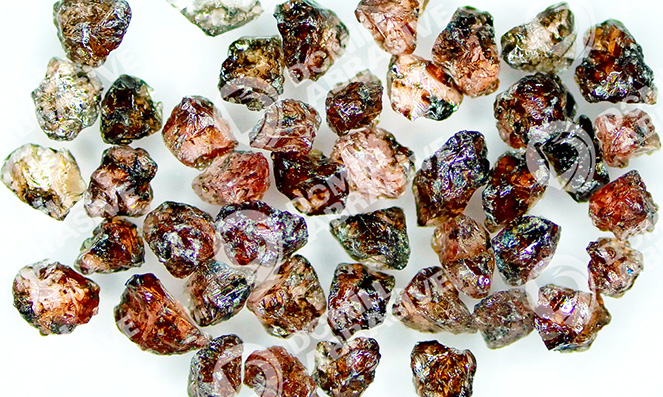
(For high-precision vitrified bonded wheels where iron compounds in the red glaze would trigger gas bubbles or chemical staining during high-temperature sintering: Transition to the non-coated, stress-relieved AT: 1050 Calcined Brown Fused Alumina.)
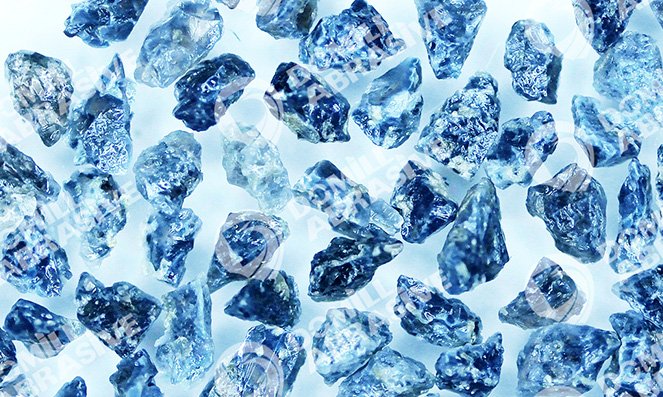
(If operating heavy-tonnage hydraulic snagging or extreme steel billet grinding where thermal shock and impact exceed standard limits: Select the recrystallized AB: 1350 Calcined Brown Fused Alumina (Blue BFA) to utilize its supreme structural toughness.)
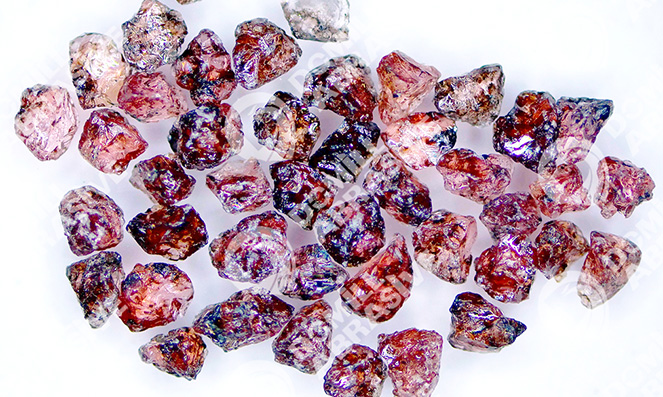
(For elite automated wide belts under extreme tensile stress or high-pressure robotic snagging requiring both peak grain toughness and peak glaze adhesion: Upgrade to the flagship ABR: Two-Stage High-Toughness Coated BFA to secure the absolute summit of physical-chemical coordination.)
Q: How does the standard "Ceramic Red Coating" dramatically enhance the bonding strength of BFA with phenolic resin binders?
A: Untreated BFA has smooth crystal faces and is inherently hydrophobic, which prevents high-viscosity liquid phenolic resins from spreading evenly on the grain surfaces. This mismatch easily traps microscopic air bubbles during bulk mixing, leaving the interface reliant on weak physical Van der Waals forces that fail under shear-load grinding, resulting in premature grain pull-out. DOMILL's ATR series addresses this by engineering a dual mechanical-chemical interlocking bridge: First, sintering the micro-crystalline glaze fuses a highly porous micro-topography over the grain. When liquid resins make contact, they are drawn into these micro-cavities via capillary forces, forming thousands of tiny "mechanical interlocks" upon curing. Second, the inorganic ceramic layer possesses exceptionally high surface energy and chemical hydrophilicity, elevating the capillary wetting height from less than 20mm to over 85mm. This permits polar groups in the resin molecules (e.g., hydroxyl groups) to form molecular-level chemical and hydrogen bonds with the inorganic oxide matrix. This ensures the mechanical keying and chemical crosslinking happen simultaneously, completely eliminating early grain shedding.
Q: What specific advantages does the ATR series offer over regular BFA in high-voltage electrostatic sand-coating lines for premium belts and flap discs?
A: In electrostatic coating, grains under a high-voltage field (exceeding 10kV) undergo dielectric polarization, creating electrostatic attraction that launches them vertically to embed points-first into the phenolic adhesive on the backing. Within milliseconds, both polarization responsiveness and aspect-ratio orientation dictate grit alignment quality. Untreated BFA possesses inconsistent surface purity, causing erratic electrical charge distribution that makes grains tumble or embed flat-side-up, reducing cut rate and promoting frictional heating on the belt. In contrast, the ATR Ceramic Coated series utilizes its inorganic surface glaze to insulate the grain from charge dissipation and surface contamination, inducing a highly symmetric electrostatic dipole response. Once in the electrical field, every single grain achieves millisecond-level alignment, driving the sharp, narrow apex of the crystal to stand upright and embed vertically into the adhesive layer. Combined with its superior hydrophilicity, the binder instantly wets the base of the grain within microseconds, establishing a robust anchor and ensuring uniform cutting height and extended tool life.
Please fill out the form.We will reply you in 24 hours.