Home / Products / White Fused Alumina / WA1: Regular White Fused Alumina
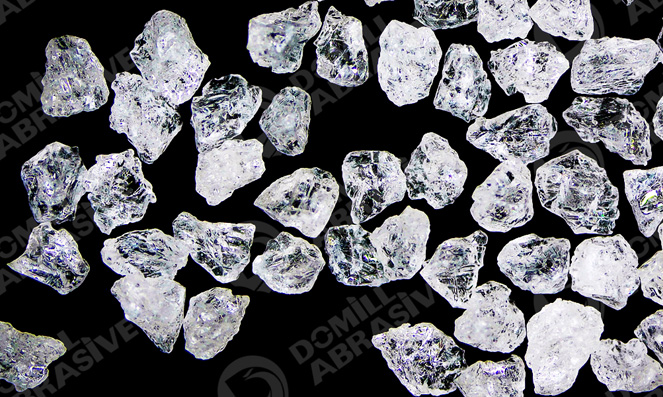
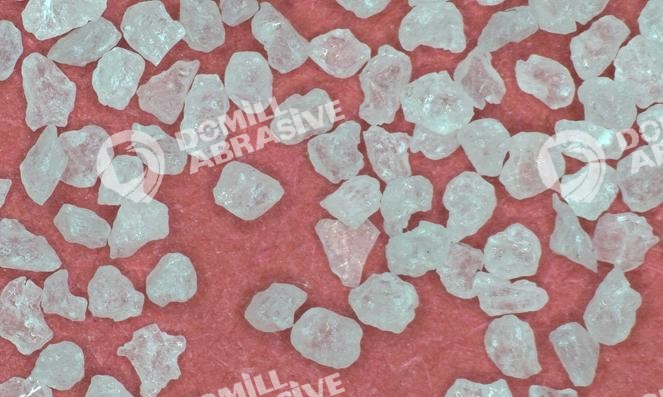
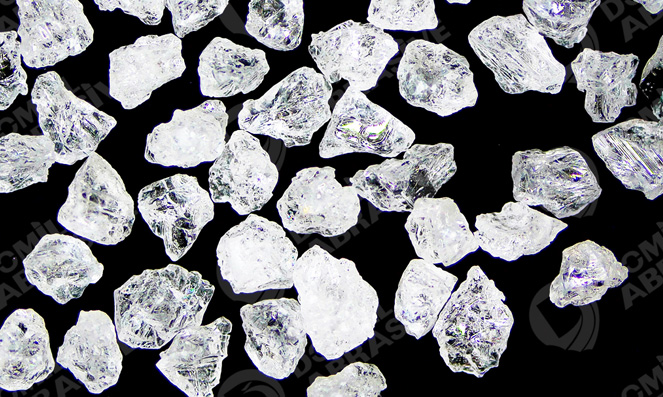
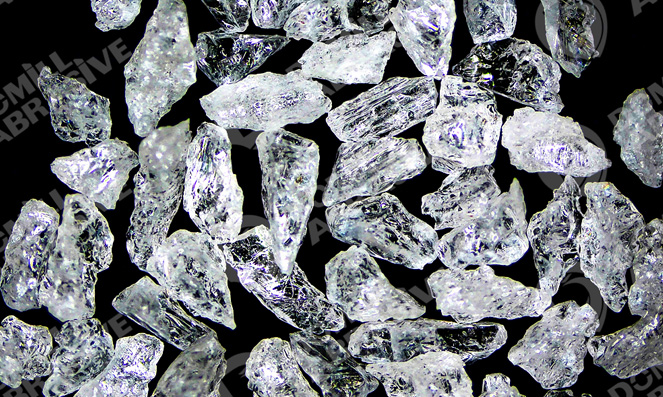
The DOMILL WA: Regular White Fused Alumina series is a high-purity synthesized abrasive engineered specifically for precision grinding, low-thermal-impact machining, and strict, contamination-free finishing.
Synthesized from premium-grade industrial alumina powder (Al₂O₃ ≥ 99.5%) fused in an electric arc furnace at temperatures exceeding 2200°C, the resulting crystalline matrix is almost entirely composed of dense α-alumina crystals. Characterized by its snow-white color, high Mohs hardness (9.0), and exceptional chemical inertness, the WA series provides a clean, highly reliable abrasive foundation for technical industries.
Compared to Brown Fused Alumina, the WA series exhibits slightly higher hardness paired with elevated friability. This distinct physical property endows the grains with superior self-sharpening mechanics: under grinding stresses, instead of slowly dulling, the grains micro-fracture along crystalline cleavage planes, continuously exposing razor-sharp new cutting edges. As a result, the DOMILL WA series drastically reduces frictional heat generation at the grinding interface, achieving "cool grinding" performance. The WA series is globally specified for precision tools, high-speed and hardened die steel grinding, non-contaminating surface preparation on stainless steel and titanium, and advanced refractory engineering.
In high-hardness tool steel precision grinding, thin-walled hardened part machining, and corrosion-resistant metal surface preparation, generic abrasives often cause part rejection due to excessive toughness or iron contamination. The DOMILL WA series targets and eliminates the following processing vulnerabilities:
Thermal Burns & Surface Micro-cracking on Tool Steels – During precision grinding of high-speed, bearing, and hardened die steels, dull grains that fail to fracture cause rapid temperature spikes. This thermal accumulation leads to localized annealing, metallurgical burns, and micro-cracking on the workpiece surface.
Iron Contamination & Rust Staining on Stainless Alloys – When blast-cleaning or polishing stainless steel, titanium, or medical alloys with generic abrasives containing free iron, microscopic iron particles embed in the substrate surface, causing localized galvanic corrosion and rust spots over time.
Wheel Glazing & Rapid Loss of Cut Rate in Precision Grinding – In automated profile grinding, tough abrasives dull without fracturing, causing grinding wheel glazing. This results in a sharp drop in material removal rate and excessive thermal generation, compromising dimensional tolerances and surface finishes.
Technical Context: The micro-hardness and friability of White Fused Alumina are sensitive to trace sodium oxide (Na₂O) levels. DOMILL controls sodium impurities through strict raw material selection and furnace dynamics. The chemical and physical specifications below are benchmarked against the FEPA F36 / P36 grit size baseline.
| Property | Specification Range | Technical Context & Guidance |
|---|---|---|
| Al₂O₃ Content | ≥ 99.5% | Ultra-high purity alumina matrix, securing exceptional hardness, electrical insulation, and refractory permanence. |
| Na₂O Content | ≤ 0.35% | Restricts soft β-alumina formation, preserving high micro-hardness across the α-phase matrix. |
| Fe₂O₃ Content | < 0.03% | Ultra-low iron fraction, preventing metallic rust contamination on stainless alloys and advanced ceramics. |
| SiO₂ Content | < 0.05% | Negligible silicate impurities, preserving structural stability under high-temperature tool sintering. |
| True Density | ≥ 3.95 g/cm³ | High-density crystal packing with minimal internal voiding. |
| Mohs Hardness / Vickers Hardness | Mohs 9.0 / ~2100 kg/mm² | Slightly harder than BFA, providing the cutting strength required for hardened steels. |
| Sizes Available | FEPA F8 - F1200 / P12 - P2500 | Full range of blocky section sands, macro-grits (F/P), and precision micro-powders available. |
| PSD | FEPA Standard 42 / GB/T 2481 | Fully compliant; JIS or ANSI particle size specs are available upon request. |
High Friability & Superior "Cool Grinding" Mechanics—The micro-crystalline friability of WA grains enables micro-fracturing along natural cleavage planes under mechanical resistance. This self-sharpening mechanism continuously renews razor-sharp cutting edges, reducing cutting drag, dampening heat accumulation, and preventing thermal damage on heat-sensitive steel alloys.
High Purity & Non-Contaminating Surface Integrity—With Al₂O₃ purity exceeding 99.5% and iron impurities held below 0.03%, the WA series introduces zero free iron onto processed surfaces. This makes it essential for air-blasting, lapping, and polishing operations on stainless valves, aerospace titanium, medical implants, and high-purity ceramic substrates.
Strictly Controlled Low Sodium & Uniform Micro-Hardness—By optimizing electric arc fusion parameters, DOMILL suppresses the formation of soft β-Al₂O₃ phases, ensuring each abrasive particle consists of pure, hard α-Al₂O₃. This delivers consistent micro-hardness and reliable grinding performance across vitrified wheels and coated abrasives.
1. Precision Vitrified Wheels for Tool & Hardened Steels—Widely deployed in vitrified gear grinding, thread grinding, slide-way finishing, and cutting-tool sharpening wheels. WA's self-sharpening and cool-cutting performance preserves precise wheel profile retention while mitigating thermal damage on high-carbon and high-speed steel components.
2. Iron-Free Blasting & Polishing for Stainless Alloys—The premier abrasive media for surface blasting and polishing of stainless steel fabrications, titanium turbine blades, nuclear piping, and aluminum castings. It efficiently strips oxides and burrs while maintaining substrate purity, preventing galvanic corrosion or iron contamination.
3. Advanced Refractory Engineering & Structural Ceramics—Utilized as a high-purity functional aggregate in shaped/unshaped refractory linings, investment casting shell molds, electrical insulators, and technical ceramic components. Its refractory temperature (exceeding 2000°C) and low impurity levels secure high volumetric permanence and slag resistance.
The WA series serves as the industry standard for precision cool grinding and iron-free processing. However, when faced with extreme shock loads or specialized chemical crosslinking demands, consult the following engineering boundaries:
If operating heavy hydraulic billet snagging or high-pressure coarse grinding: Transition to the tougher A1: Regular Brown Fused Alumina or recrystallized AB: 1350 Calcined Brown Fused Alumina to resist structural crushing.
For high-shear resinoid cut-off wheels or belts suffering from premature grain pull-out: Specify ceramic-coated WA variants or transition to ATR: Standard Ceramic Coated BFA to introduce micro-porous mechanical anchoring.
When grinding extremely ductile alloys requiring a delicate micro-toughness balance: Step up to Chrome Fused Alumina (PA Series) to leverage chromium-doped lattice reinforcement for longer edge durability.
Q: Why is White Fused Alumina (WA) significantly better suited for grinding High-Speed Steel (HSS) and hardened die steels than Brown Fused Alumina (BFA)?
A: This is fundamentally dictated by the difference in friability and grinding heat generation between the two minerals. Brown Fused Alumina (BFA) contains 2% - 3% titanium dioxide (TiO₂), providing high crystal toughness suited for heavy impact. However, when precision-grinding high-hardness tool steels, tough BFA grains resist micro-fracturing. Once the cutting tips dull, intense dry friction occurs between the flattened grain and the steel, driving grinding zone temperatures above 800°C to 1000°C. This causes localized annealing, hardness loss, and micro-cracking on the tool steel. Conversely, White Fused Alumina (WA) possesses higher alumina purity (≥ 99.5%), yielding higher micro-hardness but lower toughness (higher friability). Under grinding stresses, WA grains micro-cleave along natural crystalline planes, shedding dulled edges and exposing razor-sharp new tips (self-sharpening). This mechanics minimizes friction drag and thermal build-up, achieving "cool grinding" that protects tool steel metallurgy while maintaining strict dimensional tolerances.
Q: How does sodium oxide (Na₂O) impurity negatively affect White Fused Alumina performance, and how does DOMILL control it?
A: During electric arc fusion, sodium oxide (Na₂O) introduced from raw alumina powder reacts with Al₂O₃ at high temperatures to form β-alumina (β-Al₂O₃ or Na₂O·11Al₂O₃). Unlike high-hardness, high-density α-alumina (Mohs 9.0, density 3.95 g/cm³), β-alumina forms plate-like crystals with low micro-hardness (Mohs 7.0 - 8.0) and a soft, porous structure. If the Na₂O concentration is uncontrolled, the resulting WFA grains will contain soft β-phase inclusions, leading to erratic cutting rates, rapid abrasive breakdown, and structural voids inside vitrified grinding wheels. DOMILL mitigates this by sourcing low-sodium raw alumina and implementing precise power-input and slow-cooling dynamics during electric arc fusion. This forces sodium impurities to volatilize and segregate into the outer crust of the ingot block. Through mechanical stripping of the impurity-rich outer layer, the DOMILL WA series strictly locks finished grain Na₂O content below 0.35% (with custom low-sodium grades below 0.20%), ensuring over 99% of the crystalline matrix remains pure, dense α-alumina.
Please fill out the form.We will reply you in 24 hours.