Home / Products / White Fused Alumina / WAK: Titanium Dioxide Color-Neutral WFA
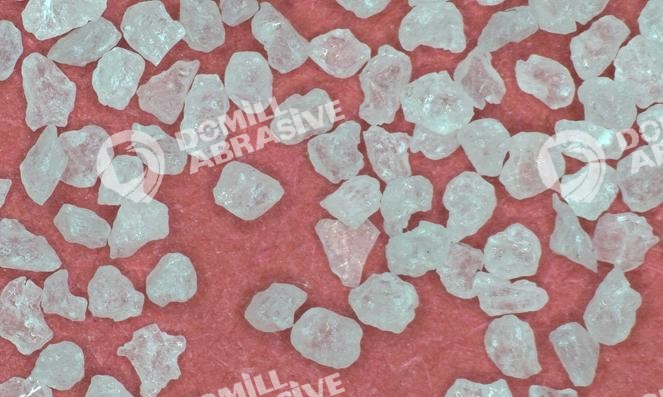
The DOMILL WAK: Titanium Dioxide Color-Neutral WFA series is a high-performance functional coated abrasive custom-engineered for medical instruments, food-grade stainless steels, cleanroom manufacturing, white/transparent resinoid wheels, and stain-free coated abrasives.
While red-coated WFA (WAR) resolves resin adhesion challenges via iron oxide coatings, applications in medical devices, food machinery, white sanding belts, and precision dental/glass grinding cannot tolerate red pigment residue or trace iron contamination. The WAK series utilizes high-purity White Fused Alumina (Al₂O₃≥99.0%) as its inner core, enveloping the grains with pure Titanium Dioxide (TiO₂) and white micro-crystalline ceramic glazes, solidified via rotary calcination at 900°C - 1100°C.
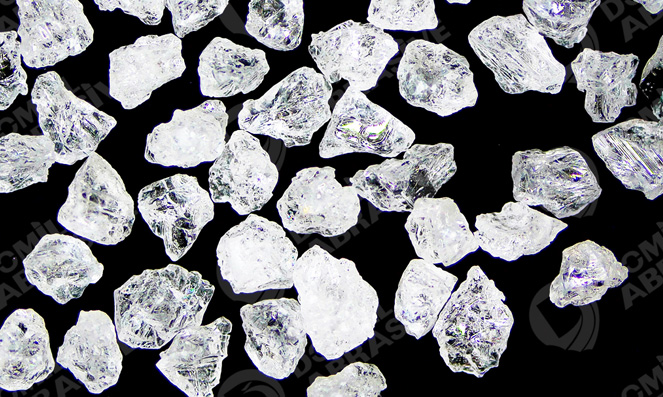
This specialized TiO₂ white coating process yields a micro-porous "white ceramic shell" on the grain surface. This color-neutral coating delivers micro-rough surface topography and capillary action (≥120 mm/10min) matching red-coated WFA, allowing liquid resin binders to instantly wet and mechanically interlock with the grain. Crucially, WAK maintains an ultra-low iron threshold of Fe₂O₃≤0.02% alongside total color neutrality. During high-speed grinding, it leaves zero pigment stains or metallic iron residues on workpieces, providing a solution for applications requiring both high resin anchorage and pristine, non-contaminating purity.
In medical instrument finishing, food/pharmaceutical-grade stainless vessel polishing, cleanroom tool dressing, and premium white sanding sheet operations, standard WFA or red-coated WFA frequently introduce severe quality defects. The DOMILL WAK series is engineered to resolve these application challenges:
Pigment Staining & Iron Contamination from Red-Coated Abrasives: Traditional red-coated WFA (WAR) offers strong adhesion, but when grinding white solid surfaces, furniture finishes, food-grade stainless, or medical titanium, crushed red iron oxide dust embeds into workpiece pores. This creates irreversible red staining and introduces free-iron contamination risks.
Premature Grain Pull-out of Smooth WFA in Transparent/White Wheels: White or clear resinoid wheels demand high visual purity. If using smooth, standard WFA, the lack of binder anchorage leads to premature grain pull-out within unpigmented resin matrices, resulting in low G-ratios and brief wheel service lives.
Poor Resin Wetting & Structural Void Defects in Moist/High-Speed Coating: During the production of premium white sanding belts and flap discs, insufficient grain surface hydrophilicity prevents liquid resin from purging micro-air bubbles at the grain base, inducing bond delamination and shedding under cyclic flexing.
Technical Context: Core evaluation metrics for the WAK series center on the microscopic adhesion of the TiO₂ white ceramic shell, strict color neutrality, ultra-low iron limits, and high capillarity. Specifications below correspond to FEPA F36 / P80 baseline standards.
| Property | Specification Matrix | Technical Context & Guidance |
|---|---|---|
| Base Al₂O₃ Content | ≥99.0% | High-purity WFA core, ensuring cool-cutting, high hardness, and rapid self-sharpening. |
| Coating Materials | TiO₂ + white micro-crystalline ceramic glaze | High-purity TiO₂ and white micro-crystalline ceramic glaze sintered into a color-neutral matrix. |
| Total Fe₂O₃ | ≤0.02% | Ultra-strict iron ceiling, guaranteeing absolute zero iron contamination or rust spotting. |
| Coating Shedding | <0.5% | Superior ceramic sintering bond; coating remains intact under washing, friction, or ultrasonic baths. |
| Capillarity | ≥120 mm / 10min | Extraordinary capillarity; transparent resin liquid wets the micro-rough grain base in milliseconds. |
| Bulk Density | Reduced by 0.03−0.08 g/cm³ vs. raw WFA | Micro-rough surface texture expands contact surface area for physical binder anchoring. |
| Added TiO₂ (Coating) | 0.30%−0.80% | Controlled TiO₂ coating thickness balancing maximum roughness with pure white aesthetic. |
| Sizes Available | FEPA F24 - F220 / P24 - P220 | Full range of FEPA F-grits for clear resinoid wheels and P-grits for color-neutral belts/discs. |
Absolute Color Neutrality & Zero Iron Contamination: DOMILL WAK substitutes pure white TiO₂ ceramic coatings for traditional iron oxide red layers, eliminating pigment transfer and iron contamination. Ground surfaces retain 100% natural material purity, making WAK ideal for medical tools, food-grade vessels, cleanroom parts, and luxury white solid surfaces.
Micro-Porous TiO₂ Shell & Molecular Interlocking: Under microscopic view, WAK grains feature micro-porous TiO₂ ceramic crusts. During the curing of transparent phenolic or epoxy binders, liquid resin penetrates deep into these micro-pores, forming a mechanical lock. Grain pull-out resistance increases by over 50% compared to standard WFA.
Micro-Second Resin Wetting & Void-Free Bond Density: With capillarity exceeding 120 mm/10min, WAK shows strong wetting affinity for clear resin binders and water-based adhesives. Liquid resins wet grain bases in milliseconds, purging trapped micro-air bubbles, eliminating structural stress voids, and elevating wheel safety at high operating speeds.
1. Medical Instruments, Titanium Bone Screws & Food-Grade Stainless
Engineered for grinding and satin finishing of surgical scalpels, titanium orthopedic implants, food-grade stainless tanks, and pharmaceutical tubing. WAK's zero-iron, stain-free properties eliminate foreign metallic or color contamination, complying with medical and food-contact purity standards.
2. Color-Neutral Resinoid Cut-Off Wheels & White Sanding Belts
Formulated for transparent/white ultra-thin resinoid cut-off wheels, flap discs, and white sanding belts (for luxury woodworking finishes and white solid surfaces). WAK's binder retention prevents grain shedding at 80 m/s cutting speeds while leaving clean, stain-free cut edges.
3. Cleanroom Tools, Dental Ceramics & Glass/Crystal Processing
Designed for cleanroom dressing tools, dental zirconia ceramic crown adjustments, and optical glass/crystal edge polishing. WAK's pure, color-neutral TiO₂ shell prevents foreign impurities from penetrating microscopic surface fissures, preserving optical clarity and bio-ceramic integrity.
The WAK series represents a color-neutral, high-adhesion functional abrasive tailored for sensitive applications. Distinguish selection parameters using these boundaries:
If grinding standard industrial stainless or carbon steel where color and iron traces are not a concern, choose the more cost-effective WAR: Iron Oxide (Red) High-Adhesion WFA, which offers identical adhesion performance.
If applied to sub-micron semiconductor CMP wafer lapping or plasma thermal spraying requiring ppm-level chemical purity: Transition to uncoated WA5: Special White Fused Alumina (Na₂O≤0.10%).
If grinding plain carbon steels or cast iron under violent mechanical shock loads: Select ATR: Standard Ceramic Coated BFA or ABR: Two-Stage High-Toughness Coated BFA to leverage high-toughness BFA cores.
Q: What are the differences in physical performance and resin adhesion between White Coated WFA (WAK) and Red Coated WFA (WAR)? Why is WAK typically higher in cost?
A: WAK (White Coated) and WAR (Red Coated) offer identical resin pull-out adhesion, capillarity, and thermal cushioning performance. The fundamental distinction lies in chemical neutrality and color non-staining:
1. Equivalent Adhesion Performance: Both the TiO₂ shell on WAK and the Fe₂O₃ shell on WAR feature micro-porous reticulated topographies with capillarity exceeding 120mm/10min. Their mechanical interlocking forces within resin matrices are equivalent.
2. Absolute Color & Zero-Iron Advantage: WAR's red iron oxide sheds colored dust during grinding and contains iron traces. WAK utilizes pure TiO₂, exhibiting a pure white/color-neutral profile with total iron ≤0.02%, preventing color staining and free-iron corrosion.
3. Cost Factors: High-purity pigment-grade TiO₂ raw materials and white iron-free ceramic glazes carry higher material costs than industrial iron oxide red. Additionally, high-temperature calcination control for white coatings demands tighter atmospheric parameters, making WAK slightly higher in manufacturing cost.
Q: Why are iron-containing or colored coated abrasives strictly forbidden in medical instruments and food-grade stainless manufacturing? How does WAK guarantee regulatory compliance?
A: Medical instruments and food/pharmaceutical containers enforce strict requirements regarding bio-compatibility and corrosion resistance. If iron-containing red coated abrasives (WAR) are applied:
First, Pitting & Corrosion Risks: Free iron particles crushed during grinding embed into micro-cavities on titanium or stainless surfaces. Under ambient moisture or saline environments, these metallic particles form micro-galvanic cells, breaking down passive oxide films and accelerating pitting corrosion.
Second, Pigment Contamination & Toxicological Risks: Organic red dyes or chemical residues lingering in device pores can trigger immune rejection or cause food-contact compliance failures.
DOMILL WAK guarantees compliance via dual safeguards: First, Iron-Free Raw Materials: Combining Al₂O₃≥99.0% WFA cores with high-purity TiO₂, total iron is held below ≤0.02%. Second, Color-Neutral Ceramic Phase: TiO₂ is a non-toxic, chemically inert white compound (widely used in pharmaceutical and food applications). Sintered at 1000°C, it releases no harmful substances, fully satisfying FDA and medical-grade cleanliness audits.
Please fill out the form.We will reply you in 24 hours.