Home / Products / White Fused Alumina / WA5: Special White Fused Alumina
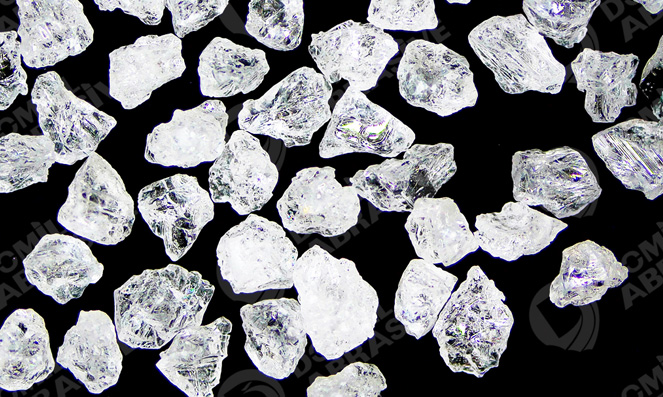
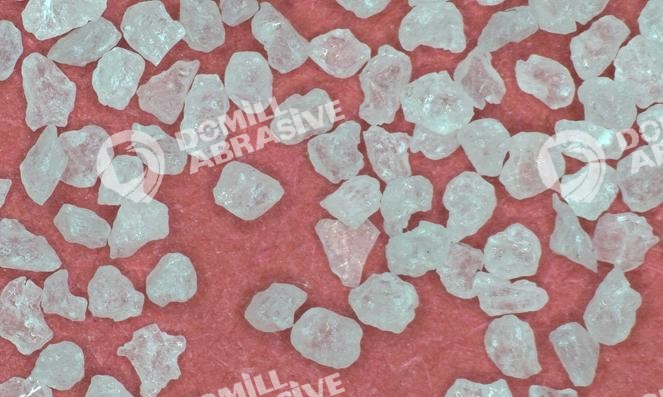
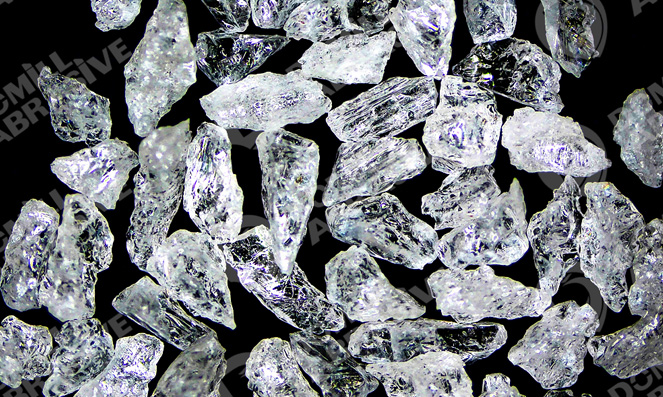
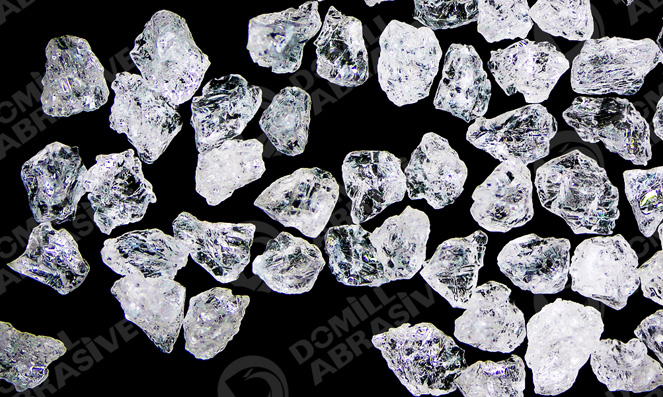
The DOMILL WA5: Special Low-Sodium White Fused Alumina series (covering the full grit spectrum from macro-grains FEPA F12 – F220 / P12 – P220 to technical fine powders F230 – F1200 / P240 – P2500 / JIS #240 – #3000) is a premier technical alumina line custom-engineered around a unified material chemistry.
It meets the rigorous demands of ultra-precision profile grinding, aerospace thermal spraying, and advanced technical ceramics. Synthesized from refined alumina raw materials using specialized arc fusion dynamics and thermal crystallization controls, the WA5 series restricts sodium oxide (Na₂O) impurities across all grain sizes to ≤ 0.15%, raising overall Al₂O₃ purity to ≥ 99.65%.
By suppressing sodium contamination, the WA5 series significantly reduces soft β-alumina (β-Al₂O₃) inclusions across both coarse grains and fine powders, ensuring an almost complete α-alumina hard crystal matrix. This endows WA5 with superior micro-hardness (2200 – 2300 kg/mm² compared to standard WFA) and uniform crystalline toughness. In macro-grain applications, it reduces vitrified sintering soft spots and premature wheel profile erosion; in fine powder applications, it minimizes volume expansion risks and electrical leakage during high-temperature ceramic firing.
In precision profile grinding, thread grinding, aerospace thermal spraying, and technical ceramics manufacturing, trace sodium and impurity phases in standard WFA cause critical systemic failures. The DOMILL WA5 series addresses these manufacturing vulnerabilities across both macro and fine size ranges:
Local Soft Spots & Wheel Profile Distortion in Vitrified Wheels – During high-temperature vitrified sintering of profile wheels using grain combinations (e.g., F60 blended with F280), Na₂O in standard WFA reacts unpredictably with vitrified bonds, forming localized soft spots and voids. This causes premature wheel corner erosion and rapid profile loss.
Non-Uniform Plasma Melting & Coating Delamination – In plasma thermal spraying, extreme flame temperatures demand consistent powder purity. Impurities in standard WFA cause non-uniform grain melting under thermal plasma jets, inducing internal stress cracks and leading to potential coating delamination under thermal shock.
Sintering Cracks & Electrical Leakage in Advanced Ceramics – When manufacturing ceramic substrates or vacuum insulating components, β-phase impurities in fine powders undergo volumetric expansion during sintering, inducing micro-cracks. Concurrently, residual sodium ions degrade high-frequency dielectric insulation and mechanical strength.
| Property | Test Standard | Macro Grains (F12–F220) | Fine Powders (F230–F1200 / JIS #240–#3000) |
|---|---|---|---|
| Al₂O₃ Purity | GB/T 3043 / ICP-OES | ≥ 99.65% | ≥ 99.65% |
| Na₂O | ICP-MS / Titration | ≤ 0.15% | ≤ 0.15% |
| Fe₂O₃ | GB/T 3043 | ≤ 0.03% | ≤ 0.03% |
| SiO₂ | GB/T 3043 | ≤ 0.04% | ≤ 0.04% |
| TiO₂ | GB/T 3043 | ≤ 0.01% | ≤ 0.01% |
| Main Phase | XRD | α-Al₂O₃ dominant (low β-phase residue) | α-Al₂O₃ dominant (low β-phase residue) |
| Mohs Hardness | Mohs scale | 9.0 | 9.0 |
| Micro-hardness | HV (50g) | 2200 – 2300 kg/mm² | 2200 – 2300 kg/mm² |
| True Density | Gas pycnometry | ≥ 3.95 g/cm³ | ≥ 3.95 g/cm³ |
| Bulk Density | FEPA Standard | 1.75 – 1.95 g/cm³ | 0.85 – 1.35 g/cm³ (depending on grit size) |
| Grit Size Range | ISO / FEPA / JIS | FEPA F12 – F220 / P12 – P220 | FEPA F230 – F1200 / P240 – P2500 / JIS #240 – #3000 |
Controlled Low Sodium & High Crystal Hardness – By suppressing Na₂O below 0.15%, WA5 minimizes soft β-Al₂O₃ formation. Micro-hardness maintains a high 2200 – 2300 kg/mm², yielding a dense crystalline matrix that withstands high-speed profile grinding.
Superior Wheel Edge Retention & Vitrified Compatibility – WA5 grains minimize unpredictable reactions with vitrified bonds during 1000°C – 1250°C wheel sintering. Vitrified wheels exhibit improved edge retention and profile permanence during automated gear and thread grinding.
Sintering Volumetric Stability & Electrical Insulation – Low impurity levels ensure volumetric stability during high-temperature ceramic body sintering, helping reduce shrinkage distortion. Low residual sodium supports good electrical insulation performance.
1. Precision Vitrified Wheels for Gears, Threads & Tools – Engineered for vitrified gear profile wheels, ball-screw grinding wheels, and CNC tool grinding wheels. Wheel formulations combine WA5 macro-grains with WA5 fine powders to achieve optimal packing density and wheel profile retention.
2. Aerospace & Industrial Plasma Thermal Spraying Powders – Serves as alumina powder feedstocks for Thermal Barrier Coatings (TBC), plasma insulation spraying, and wear-resistant coatings. Low impurities support consistent plasma melt flow, high deposition efficiency, and thermal shock resistance.
3. Technical Ceramics & Special Refractories – Applied in manufacturing ceramic substrates, vacuum insulators, ceramic structural components, and high-purity kiln furniture. Sodium controlled below 0.15% ensures reliable insulation, strength, and structural integrity.
The WA5 series represents a versatile low-sodium grade across macro and technical fine size ranges. Align application choices using these technical-economic boundaries:
For standard tool steel grinding or general stainless steel processing without strict sodium limits: Select WA1: Regular White Fused Alumina as a cost-effective standard.
If manufacturing coated abrasives requiring standard P-grade particle size distribution and specialized surface treatment: Transition to WA2: White Fused Alumina For Coated Abrasives.
For heavy-duty coated belts or grinding discs requiring maximum grain retention and bond strength under shear stress: Upgrade to WAR: Iron Oxide (Red) High-Adhesion WFA.
When color neutrality is required in bonded tools or aesthetics-sensitive coated abrasives without iron-oxide red tinting: Specify WAK: Titanium Dioxide Color-Neutral WFA.
Q: Why must sodium oxide content be controlled at ≤ 0.15% in precision vitrified wheels, thermal spraying, and ceramics?
A: Sodium oxide (Na₂O) is a key impurity in white fused alumina. During electric fusion, sodium reacts with alumina to form β-alumina (β-Al₂O₃). β-alumina forms soft, plate-like crystals with a Mohs hardness of only 7.0 – 8.0 (compared to Mohs 9.0 for α-alumina).
Standard WFA (WA1) typically contains 0.20% – 0.45% Na₂O, containing soft β-phase inclusions. In precision vitrified wheels and technical ceramics, β-alumina can cause abnormal vitrified bond reactions or thermal volume changes during 1000°C sintering. The DOMILL WA5 series controls Na₂O to ≤ 0.15%, reducing β-phase inclusions and securing a high-hardness α-alumina dominant matrix.
Q: What role do WA5 fine and technical micro-powders (F230–F1200) play in vitrified wheel formulations?
A: Precision vitrified wheel formulations often use a bimodal or multi-modal grain packing design (combining coarse grains with fine powders) to maximize green density and sintered strength.
If low-sodium coarse grains are combined with high-sodium standard fine powders, the sodium in the fine particles will still react unpredictably with the vitrified bond during firing. WA5 fine powders share the identical low-sodium chemistry (Na₂O ≤ 0.15%) as the macro-grains, ensuring chemical and thermal uniformity throughout the wheel matrix for consistent sintering and profile longevity.
Please fill out the form.We will reply you in 24 hours.