Home / Products / Treated & Calcined Brown Fused Alumina (BFA) / AB: 1350 Calcined Brown Fused Alumina
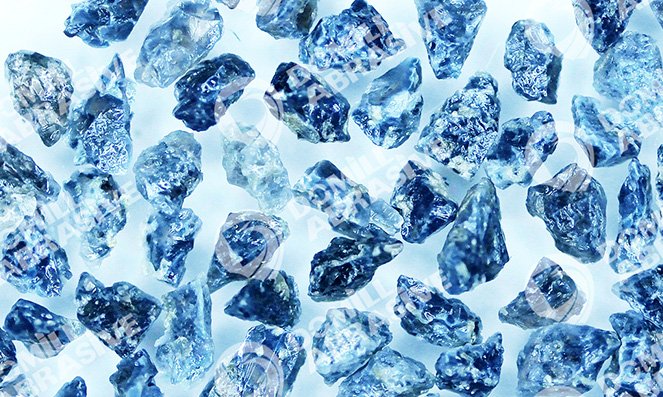
The DOMILL AB: 1350 Calcined Brown Fused Alumina series represents the pinnacle of physical toughness and thermal endurance in our thermally conditioned portfolio.
Under this 1350°C thermal oxidation threshold, trace volatile components and lower-valence titanium elements are deeply oxidized and fully integrated as solid solutions within the corundum lattice, eliminating any risk of destructive thermal expansion. This provides the grains with outstanding thermal shock resistance and exceptional single-grain compressive toughness. Furthermore, the high-fired process drives surface hydrophilicity and micro-roughness to the physical limits of non-coated abrasives. Whether utilized in heavy-duty snagging wheels, high-speed rail track cutting discs, or high-tension automated wide belts, the AB series delivers prolonged service lifespans and highly predictable self-sharpening mechanics, serving as a key solution to premature wheel rupture and grain dullness in heavy industries.
In heavy-duty industrial snagging, high-speed rail track maintenance, and continuous high-tension sanding, massive instantaneous shear forces paired with escalating grinding heat impose destructive stresses on conventional abrasives. The DOMILL AB: 1350 Calcined BFA is thermally optimized to prevent and eliminate the following systemic failure risks:
Thermal Fatigue & Cracking in High-Heat Grinding: During billet snagging or rail cutting, instantaneous contact temperatures frequently exceed 1200°C. Standard abrasives subjected to such violent thermal shock suffer from localized softening or uneven thermal expansion along impurity-rich grain boundaries, triggering sudden pulverization and a dramatic drop in grinding ratios.
Volumetric Expansion & Cracking in Tool Sintering: During the 950°C–1150°C sintering of vitrified bonded wheels, low-valence titanium and free iron residues in untreated BFA absorb oxygen, expand, and outgas. This introduces microscopic fissures and structural warping inside the wheel matrix, severely compromising burst safety and dynamic balance.
Grain Pull-out & Premature Dullness under High Tension: In automated metal plate grinding, heavy-duty wide belts operate under extreme tensile and shear forces. If the grains lack sufficient fracture toughness or exhibit poor wetting with binder adhesives, they will prematurely pull out or dull rapidly, causing belt slippage and burning the workpiece surface.
Technical Context: The extreme 1350°C calcination process forces complete oxidation and burns off all Loss on Ignition (LOI). To establish a highly precise baseline, DOMILL benchmarks the physical and chemical specifications of the AB series using FEPA F36 grit size as the reference.
| Property | Specification Matrix | Technical Context & Guidance |
|---|---|---|
| Al₂O₃ Content | 95.5%–96.8% | Volatiles are completely eliminated, driving alumina purity to the theoretical ceiling of the BFA category. |
| TiO₂ Content | 1.5%–2.8% | Titanium ions are fully dissolved within the alumina lattice to form a solid solution, eliminating boundary segregation. |
| Fe₂O₃ Content | < 0.08% | Iron residue is extremely minimized, preventing thermal stress reactions during vitrified sintering. |
| SiO₂ Content | < 0.6% | Minimal silica fraction, securing grain boundaries against structural creep under severe thermal loads. |
| Magnetic Content | ≤ 0.0010% | Advanced purification ensures minimal free iron spots, eliminating expansion-induced tool failure. |
| Toughness Increment | +30%–40% | A significant enhancement in fracture toughness compared to the A1 series, due to complete crystal recrystallization. |
| Hydrophilicity Height | ≥ 75 mm / 10min | Exceptional surface energy. Reaches a peak capillary height for uncoated grains, ensuring optimal resin wet-out. |
| Sizes Available | FEPA F8–F220 | High-impact blocky section sands, narrow-distribution grits, and custom grain fractions available. |
| Particle Size Standard | FEPA Standard 42 / GB/T 2481 | Fully aligned; JIS or ANSI sizing specifications are available upon request. |
Deep Crystalline Recrystallization & Superior Toughness: The extreme 1350°C heat induces partial recrystallization within the corundum structure, deeply healing micro-shears while optimizing unit cell packing. This drives single-grain compressive toughness (L75 index) up by 30% to 40% over standard grains, enabling the abrasive to endure intense centrifugal forces and massive material removal resistance without premature failure.
Exceptional Thermal Shock Resistance & Volume Permanence: Through thorough high-temperature thermal reactions, unstable titanium and iron compounds complete their phase transformations and lattice solubilization. This ensures the abrasive exhibits negligible structural expansion when exposed to grinding heats over 1000°C. This permanent volume stability yields exceptionally low warping rates during wheel sintering and minimizes physical wear in aggressive dry grinding.
Pristine Surface Purity & Superior Mechanical Interlocking: The 1350°C thermal airflow thoroughly strips off surface dust and carbonizes organic impurities, exposing a highly active, pristine micro-rough surface with a capillary rise height exceeding 75mm. Combined with a blocky morphology, this ensures dense mechanical interlocking with resin or vitrified bonds, significantly minimizing grain pull-out under heavy loads.
1. Billet Snagging & Heavy-Duty Grinding Wheels: Widely used for manufacturing large-format, high-rigidity snagging wheels in heavy industries. When processing hardened steel billets, casting risers, and superalloys, the heavy-duty recrystallized phase of the AB series resists extreme hydraulic thrusts while maintaining steady self-sharpening mechanics under high removal rates.
2. High-Speed Rail Track & Heavy-Duty Cut-Off Wheels: Exclusively deployed for performance-grade track-maintenance wheels operating at high linear speeds (80–100 m/s) with extreme thermal shock resistance requirements. With structural expansion risks eliminated, these cutting discs deliver outstanding burst safety and structural integrity under high dry-cutting heats.
3. High-Strength Automated Sanding Belts: A premier aggregate for manufacturing ultra-wide, heavy-duty belts designed for continuous automatic stainless steel polishing and cold-rolled sheet finishing lines. The high-density blocky morphology paired with superb resin wetting prevents premature grain shedding under severe tension, securing maximum continuous line uptime.
The AB series represents the performance ceiling for non-coated BFA. For specific system alignment, consult the following engineering boundaries to decide on upgrades or down-adjustments:
(If executing standard vitrified grinding or medium-load bonded tools where processing heat remains moderate: Opt for the more balanced AT: 1050 Calcined Brown Fused Alumina to heal lattice stress cost-effectively.)
(For high-shear resinoid tools or flap discs where mechanical interlocking alone is insufficient to halt grain pull-out: Step up to the ATR: Standard Ceramic Coated BFA to introduce a high-roughness ceramic-coated anchoring bridge.)
(For high-performance automated wide belts and ultra-heavy billet snagging seeking both the ultimate grain toughness and chemical-glaze crosslinking: Upgrade to the ABR: Two-Stage High-Toughness Coated BFA to secure an optimal combination of material properties.)
Q: Why does Brown Fused Alumina turn deep blue-black (commonly known as Blue Fired Alumina) after calcining at 1350°C? What is the chemical nature of this color shift?
A: The natural brown hue of standard BFA stems from titanium, iron, and silicon oxides precipitating along the alumina grain boundaries during cooling, forming unstable titanaugite and iron titanate micro-phases. During the intensive 1350°C high-temperature calcination, the massive thermal activation energy drives lower-valence titanium (such as Ti³⁺) to thoroughly oxidize into stable tetravalent titanium (Ti⁴⁺). These titanium ions then readily diffuse from the boundaries into the α-alumina lattice cells. As Ti⁴⁺ ions replace Al³⁺ ions within the corundum structure, they form a highly uniform, thermodynamically stable α-Al₂O₃-TiO₂ solid solution. The specific molecular light absorption of this solid solution produces the characteristic deep blue-black coloration. This color shift is the definitive chemical signature indicating successful lattice healing, boundary impurity resolution, and absolute structural phase stabilization.
Q: What is the fundamental breakthrough of 1350°C calcination (AB Series) in resisting heavy-duty grinding thermal fatigue compared to 1050°C calcination (AT Series)?
A: Under severe heavy-duty operations like billet snagging and rail cutting, instantaneous contact heats routinely exceed 1200°C. The AT series (1050°C calcined) focuses on releasing mechanical internal stresses from crushing under a moderate thermal threshold. This provides excellent fracture resistance in standard or medium-load tools. However, when exposed to persistent heats above 1200°C, the lack of deep recrystallization means trace low-melting-point silica and titanate phases at the grain boundaries will soften or undergo secondary volume expansion, triggering thermal fatigue cracking and brittle failure. In contrast, the AB series (1350°C calcined) has already surpassed the melting thresholds of these boundary impurities during manufacturing, forcing complete lattice healing and titanium solid-solution diffusion. Consequently, the AB series grains not only possess elite single-grain toughness (a 30% to 40% rise in the L75 index) but also maintain superior dimensional and structural rigidity when subjected to continuous 1200°C cutting heats. This eliminates rapid abrasive dulling caused by thermal fatigue, establishing superior grinding durability.
Please fill out the form.We will reply you in 24 hours.