Home / Products / White Fused Alumina / WA2: White Fused Alumina For Coated Abrasives
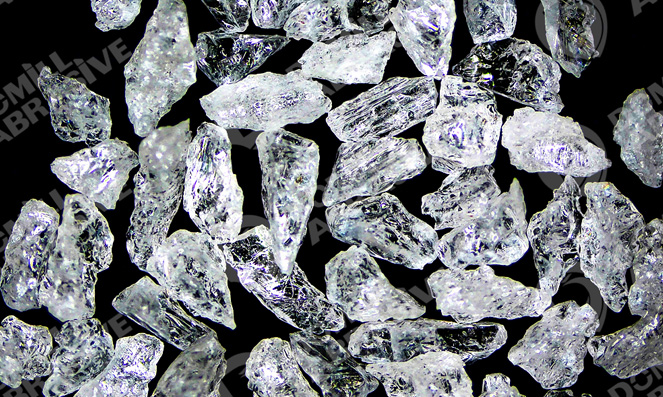
The DOMILL WA2: White Fused Alumina For Coated Abrasives series is engineered specifically for converted abrasive products including sanding belts, abrasive sheets, vulcanized fiber discs, flap discs, and precision polishing films. Synthesized from high-purity industrial alumina in electric arc furnaces at temperatures exceeding 2200°C, the mineral maintains a high purity baseline of Al₂O₃ ≥ 99.50%.
Synthesized from high-purity industrial alumina in electric arc furnaces at temperatures exceeding 2200°C, the mineral maintains a high purity baseline of Al₂O₃ ≥ 99.50%. Unlike standard FEPA F-grit grains destined for vitrified or bonded wheels, the WA2 series undergoes dedicated grain morphology shaping and surface physicochemical tuning to optimize electrostatic deposition and resin binder anchoring.
The WA2 series utilizes specialized roll-crushing and air-stream shaping circuits to optimize grain sharpness and needle/flake ratios. This engineering controls the bulk density to achieve optimal electric charge responsiveness under high-voltage electrostatic sand-planting fields (over 100 kV), guaranteeing maximum upright grain orientation (where the major axis orients perpendicular to the flexible backing). Adhering strictly to FEPA Standard 43/ISO 6344 (P-Series) specifications, the coarse-limit particle distribution is tightly capped to prevent rogue-grain surface scratching. Coupled with enhanced surface hydrophilicity, WA2 establishes an exceptional crosslinking bond with phenolic and epoxy resin systems, securing sharp cut-rates and anti-shedding longevity for coated tools.
In high-speed sanding belt grinding, stainless steel sheet finishing, and precision woodworking, standard abrasives often suffer from non-optimized shapes or broad particle distribution, leading to premature product failure. The DOMILL WA2 series is engineered to resolve these coated manufacturing challenges:
Poor Electrostatic Orientation & Flat-Lying Grains: Grains with uneven electrostatic charge, high magnetic residues, or overly blocky shapes fail to orient vertically under electrostatic planting fields. This creates flat-lying grains embedded in the binder, severely impairing the initial sharpness and cut-rate of sanding sheets and belts.
Deep Surface Scratches Caused by Out-of-Spec Coarse Grains: Coated abrasives rely on precise single-layer or double-layer grain deposition. If sieve standards allow coarse tailing, protruding oversize grains will cut deep, irreversible scratches across workpieces during high-speed belt pass operations.
Inadequate Resin Interlocking & Premature Grain Shedding: Due to the smooth crystal surface of standard WFA, phenolic binders may fail to fully wet the grain base without high surface energy. Under continuous belt flexing and tensile stresses, grains experience premature pull-out, leading to early tool failure and bare spots.
Technical Context: Coated abrasive P-grits differ significantly from bonded abrasive F-grits in particle size distribution (PSD) curves and bulk density controls. The WA2 series is benchmarked against FEPA P-Series / ISO 6344 standards. Specifications below use FEPA P36 / P80 as baseline reference points.
| Property | Specification | Technical Context |
|---|---|---|
| Al₂O₃ Content | ≥ 99.50% | Ultra-pure α-alumina matrix, securing superior self-sharpening ability and non-contaminating properties. |
| Na₂O Content | ≤ 0.30% | Restricts soft phase formation, maintaining uniform micro-hardness and sharp micro-fracturing. |
| Fe₂O₃ Content | < 0.03% | Ultra-low iron fraction, preventing rust spots or discoloration on stainless alloys and fine wood. |
| Bulk Density | 1.52 – 1.78 g/cm³ | Tuned specifically per grit size to balance sharp cutting aggression and mechanical resistance. |
| Orientation Ratio | ≥ 92% | Over 92% of grains align vertically along their major axis under high-voltage electrostatic fields. |
| Hydrophilicity Height | ≥ 85 mm / 10min | Excellent surface energy ensures micro-second resin wetting without micro-void traps. |
| Sizes Available | FEPA P12 – P2500 / ISO 6344 | Full range covering coarse P-grits, medium P-grits, and precision P-Micro powders. |
| PSD Standard | FEPA Standard 43 / ISO 6344 / GB/T 9258 | Fully compliant with international coated abrasive standards; 100% cutoff on oversize coarse grains. |
Custom Morphology & Peak Electrostatic Orientation: DOMILL WA2 incorporates proprietary shape classification to optimize aspect ratios and bulk density. The grain surfaces undergo charge-activation processing for uniform performance in 100kV electrostatic fields. Over 92% of the grains plant vertically with their sharpest apex upward, forming a "razor-blade array" that dramatically accelerates cut-rates.
Strict FEPA P Sizing & Zero-Scratch Quality: Compared to generic F-grits, FEPA P-grit standards enforce ultra-strict limits on the coarse tail of the distribution curve. The WA2 series uses multi-stage air classification and ultra-precise screens to eliminate 100% of oversize particles, ensuring sanding belts deliver predictable surface roughness (Ra/Rz) with zero rogue scratches.
Superior Resin Affinity & Flexible Anti-Shedding Grip: Through thermal conditioning and surface cleaning, WA2 grains exhibit superior surface energy with capillary rise heights exceeding 85mm. Liquid phenolic make-coats wet the micro-rough grain bases completely at a molecular level. Even under severe belt flexing over small contact wheels, the grains remain anchored, effectively preventing grain shedding.
1. Premium Sanding Belts for Stainless Steel & Titanium: Engineered for converted wide, narrow, and segment belts used in polishing stainless sheets, tubing, titanium parts, and turbine blades. WA2's high purity prevents ferrous contamination and thermal discoloration, delivering bright, uniform satin finishes.
2. Vulcanized Fiber Discs, Flap Discs & Unmounted Wheels: Deployed in vulcanized fiber discs and flap discs for angle grinders. WA2's high electrostatic orientation and strong binder interlocking allow tools to sustain heavy lateral shear forces during weld seam dressing and deburring without shedding.
3. Precision Woodworking & Automotive Refinish Sheets/Films: Formulated for wet/dry paper sheets and PET micro-finishing film belts (P600 – P2500) in luxury woodworking, musical instruments, and automotive OEM paint refinishing. The tight P-micro distribution eliminates paint defects efficiently while leaving fine, uniform scratch patterns that are easily polished out.
The WA2 series is a specialized grade tailored for flexible coated abrasives. Align your technical selections using the following boundaries:
WAR: Iron Oxide (Red) High-Adhesion WFA When manufacturing heavy-duty coated belts or grinding discs requiring extra physical/chemical locking against intense shear forces, upgrade to WAR.
WAK: Titanium Dioxide Color-Neutral WFA For applications requiring enhanced coating adhesion without aesthetic red coloration, select WAK.
WA5: Special White Fused Alumina For CMP polishing, thermal spraying, or high-precision profile vitrified wheels requiring strict low-sodium limits, specify WA5 (Na₂O ≤ 0.15%).
Q: What are the fundamental differences in production control between coated P-grits (FEPA P-Grit) and bonded F-grits (FEPA F-Grit) for White Fused Alumina? Why are they not interchangeable?
A: Although P-grits (like WA2) and F-grits (like WA1) share high-purity alumina chemistry, they differ fundamentally in Particle Size Distribution (PSD), Grain Morphology, and Surface Electrostatics, making them non-interchangeable:
1. Different PSD Curves: The FEPA P standard is engineered for single/double-layer coated tools, enforcing far stricter cutoffs on the "coarse tail" than F standards. P-grits require 100% elimination of oversize particles to prevent surface scratches, while fine fraction limits are also tuned differently.
2. Distinct Grain Morphology & Bulk Density: F-grits for 3D bonded wheels require equi-axed, blocky shapes to maximize wheel structural density. Conversely, P-grits for coated tools demand higher grain sharpness and specific aspect ratios to facilitate electrostatic flight and vertical alignment.
3. Electrostatic & Hydrophilic Treatments: P-grits undergo active surface charge tuning and wetting treatments to ensure smooth flight and vertical planting under 100kV fields, as well as rapid wetting by thin resin coats. Using F-grits on sanding belts causes flat-planted grains, deep scratches, and premature grain shedding.
Q: How does the DOMILL WA2 series achieve a high electrostatic orientation ratio (≥ 92%) during sand-planting?
A: Electrostatic sand-planting utilizes high-voltage electric fields (50kV – 120kV) to charge abrasive grains, propelling them upward into the adhesive-coated backing. Achieving an orientation ratio where ≥ 92% of grains stand vertically requires precise control across three domains:
First, Sharp Aspect-Ratio Shaping: Specialized roll-crushing and air-shaping systems eliminate blocky or rounded particles, locking the grain aspect ratio into the optimal window for electrostatic flight.
Second, Surface Charge Polarization: WA2 undergoes surface modification to clear electrostatic shielding layers. When entering the electric field, opposite charges are instantly induced at the extreme ends of each grain's major axis (generating a strong Dipole Moment). The electric torque rotates the grain mid-flight, forcing its sharpest tip upward into the resin.
Third, Ultra-Low Magnetic Residue: Metallic or magnetic impurities disrupt local electric fields and cause grain agglomeration. WA2 passes through 12,000-Gauss high-intensity magnetic separators, reducing magnetic content to near-zero. This ensures grains fly individually without clumping, maximizing initial cutting aggression and uniform grit spacing.
Please fill out the form.We will reply you in 24 hours.