Home / Products / White Fused Alumina / WAR: Iron Oxide (Red) High-Adhesion WFA
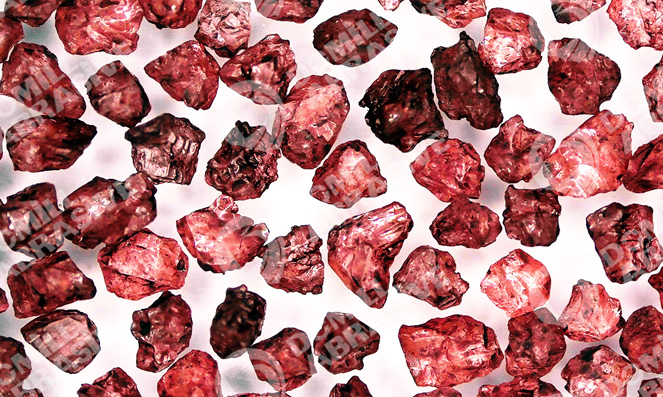
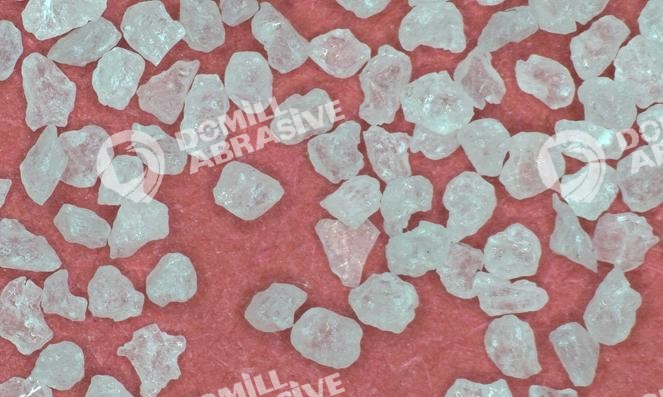
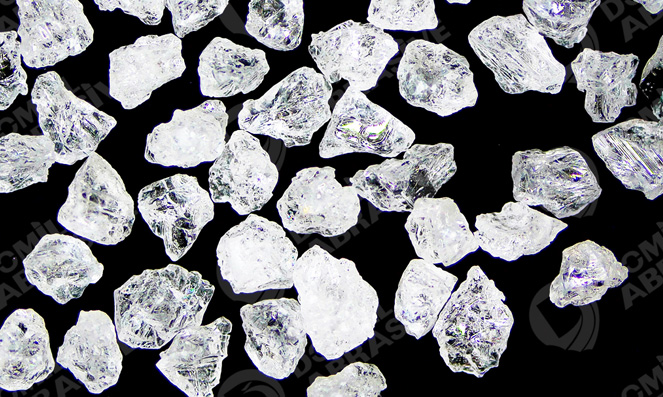
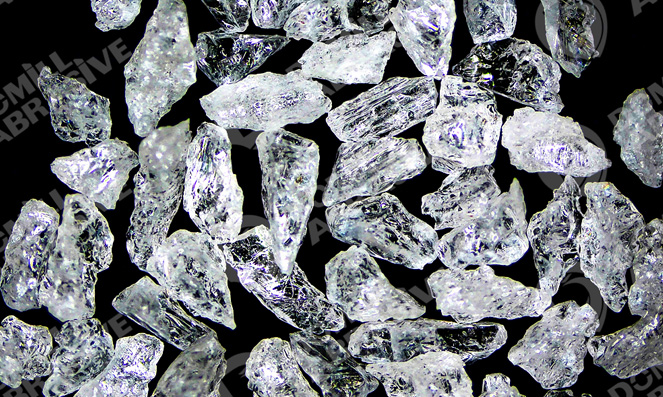
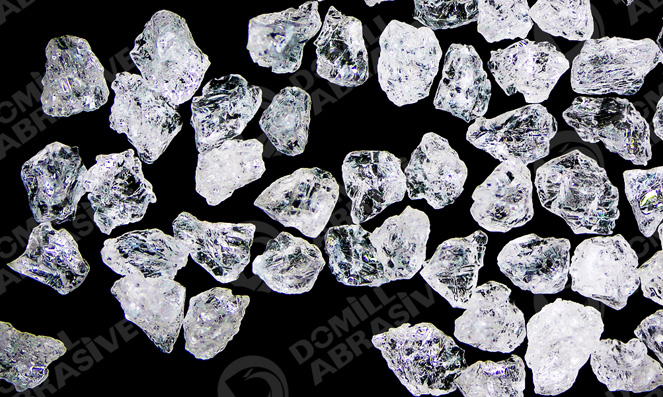
The DOMILL WAR: Iron Oxide (Red) High-Adhesion WFA series is a high-performance functional abrasive engineered by DOMILL to resolve the inherent surface smoothness, weak resin adhesion, and premature grain pull-out associated with standard White Fused Alumina.
Utilizing ultra-pure White Fused Alumina (Al₂O₃≥99.0%) as its internal structural core, the WAR series applies a uniform coating of high-affinity iron oxide red (Fe₂O₃) and micro-crystalline ceramic glaze, solidified through rotary calcination at 800 °C – 1,050 °C.
Following this advanced ceramic coating process, the grain surface transforms from a smooth, vitrified lattice into a micro-porous, highly textured "rough ceramic shell." This red sintered layer elevates the grain surface energy and specific surface area, doubling the capillary rise height compared to standard WFA. During the manufacturing of resinoid cut-off discs and coated sanding belts, liquid phenolic resin instantly penetrates the microscopic pores, building powerful "mechanical interlocking" and chemical crosslinking. Additionally, the red ceramic shell functions as a thermal and shock buffer during high-speed dry grinding, suppressing localized thermal and impact damage. This enables the WAR series to retain WFA's cool-cutting characteristics while matching Brown Fused Alumina in anti-pullout adhesion.
Dry grinding, high-speed cut-off, and surface conditioning of carbon steels, alloy steels, and stainless alloys present conflicting demands for extreme grain sharpness versus binder anchorage strength. The DOMILL WAR series is engineered to resolve these manufacturing hurdles:
1. Resin Delamination & Premature Grain Pull-out on Smooth WFA: Standard WFA features a smooth crystal surface that relies on weak physical forces to bond with resinous matrices. Under high-speed rotation (>80 m/s) or high belt tension, whole grains pull out long before dulling, leading to rapid wheel consumption and poor abrasive efficiency.
2. Thermal Stress Accumulation & Grain Thermal Shattering in Dry Grinding: WFA possesses lower toughness than BFA. In heavy dry grinding without coolant, severe thermo-mechanical shocks penetrate the exposed crystal matrix directly, triggering premature grain shattering and loss of progressive cutting ability.
3. Sluggish Resin Wetting & Micro-Void Traps in Mixing/Planting: During resinoid batch mixing or electrostatic sand planting, smooth WFA surfaces resist rapid liquid resin wetting. Sluggish liquid flow traps micro-air bubbles along grain-matrix interfaces, creating structural voids and weakening overall tool integrity.
Technical Context: Core evaluation parameters for the WAR series encompass internal WFA purity (Al₂O₃), coating adhesion stability, capillary rise height, and bulk density shifts. Specifications below correspond to FEPA F36 / P80 standards.
| Test Parameter | Standard WFA | DOMILL WAR | Test Method |
|---|---|---|---|
| Al₂O₃ Core Purity (%) | ≥99.50% | ≥99.00% | GB/T 3043 / ISO 9286 |
| Fe₂O₃ Coating Addition (%) | ≤0.03% | 0.30%−0.80% | XRF / Titration |
| Capillarity Height | 50–60 mm/10 min | ≥120 mm/10 min | FEPA Standard 44-GB-1986 |
| Bulk Density Shift | Baseline (1.75–1.85 g/cm³) | Decrease 0.03–0.06 g/cm³ (increased surface area) | FEPA Standard 44-D-1986 |
| Calcination Temp | N/A (not calcined) | 800°C−1,050°C (medium-high temp ceramic curing) | DOMILL Internal Standard |
| Coating Shedding Rate | N/A | <0.5% (water washing/ultrasonic test) | DOMILL Adhesion Test |
| Resin Interface Shear Strength Increase | Baseline (100%) | Increased 40%−60% |
Single Grain Pull-out Test |
1. Micro-Porous Ceramic Shell & Molecular Interlocking: DOMILL WAR's iron oxide ceramic coating features a micro-rough reticulated mesh, turning smooth faces into "micro-interlocking teeth." Curing resinoid binders penetrate deep into these pores, locking each grain tightly in the matrix. Interface pull-out strength increases by 40% to 60%, resolving premature grain shedding under severe stresses.
2. Thermal Shock Cushioning & Controlled Progressive Fracturing: The outer ceramic shell acts as a "micro-shock absorber," attenuating instantaneous thermo-mechanical impacts. Rather than suffering catastrophic structural shattering upon impact, the protected WFA core undergoes controlled micro-fracturing along crystal boundaries, continuously refreshing cutting edges and extending tool life.
3. Micro-Second Resin Wetting & Pore-Free Structural Density: With capillary rise heights exceeding 120 mm/10 min, WAR exhibits exceptional wetting affinity for liquid phenolic and epoxy resins. Liquid binders wet grain surfaces in milliseconds, purging micro-air films along interfaces, eliminating structural stress defects, and enhancing bursting safety for cut-off wheels.
1. Premium Ultra-Thin Cut-Off Wheels & Heavy-Duty Grinding Discs: Designed for ultra-thin cut-off wheels (1.0 mm – 1.6 mm) and heavy grinding discs for stainless steel and alloy steels. WAR's intense binder interlocking ensures high-speed structural safety (80 m/s – 100 m/s) with zero grain shedding, while its cool-cutting WFA core delivers burr-free cuts without thermal discoloration.
2. Heavy-Duty Vulcanized Fiber Discs, Flap Discs & Abrasive Mesh: Engineered for heavy weld seam grinding and edge deburring using angle grinders. The red ceramic coating equips grains with exceptional resistance to lateral shear forces, maintaining cutting rates 35% higher than standard WFA tools.
3. Precision Vitrified/Resinoid Dry-Grinding Wheels for Sensitive Steels: Engineered for dry profile grinding of bearing steels, tool steels, and die steels. WAR's ceramic coating buffers thermal surges while the WFA core cuts cleanly, preventing workpiece micro-cracks or annealing soft spots.
The WAR series represents a high-adhesion modified abrasive engineered to solve binder interface and thermal shock issues. Distinguish selection parameters using these boundaries:
If running fully flooded wet grinding on nuclear-grade alloys or semiconductors where any trace iron contamination is prohibited: Choose iron-free SWA: Special White Fused Alumina or WA: Regular White Fused Alumina.
If grinding low-tensile-strength cast irons or plain carbon steels where lower grain cost is key: Transition to ATR: Standard Ceramic Coated BFA for cost-effective BFA-based toughness.
For extreme tonnage automated billet snagging requiring maximum crushing resistance: Upgrade to ABR: Two-Stage High-Toughness Coated BFA to leverage a heavy-duty recrystallized core.
Q: White Fused Alumina is known for high purity, zero iron contamination, and cool cutting. Why add an iron oxide (Fe₂O₃) red coating, and will this compromise WFA's inherent benefits?
A: This represents a classic material engineering balance. Red ceramic coating does not compromise WFA's cutting advantages; rather, it eliminates its key physical limitation:
1. Precise Trace Controls: The added Fe₂O₃ in the WAR series is held to a minimal 0.30% – 0.80% and fully vitrified with silicates at 1,000 °C into an insoluble ceramic matrix. For standard stainless cut-off tools and sanding belts, the coating remains locked within the cured resin matrix without shedding free iron.
2. Resolving the "Sharp Cut but Weak Retention" Paradox: While pure WFA cuts razor-sharp with low thermal build-up, its smooth faces cause severe premature grain pull-out in resinoid matrices. If grains shed early, their cutting benefits are wasted. WAR's red coating locks the grains into the binder, allowing them to perform until fully worn down via micro-fracturing, extending tool life multiple times over.
Q: What are the fundamental performance differences between Red Coated WFA (WAR) and Red Coated BFA (ATR)? How should engineers choose between them?
A: Although WAR and ATR share similar red ceramic surface appearances, their internal crystal cores dictate distinct grinding mechanics and target applications:
Core Matrix & Cutting Mechanism:
ATR (BFA Core): Features high toughness and moderate micro-hardness (HV ~1,800). It resists structural shattering under heavy shock loads, excelling in heavy carbon steel and cast iron grinding.
WAR (WFA Core): Features ultra-high purity (Al₂O₃≥99%), superior micro-hardness (HV ~2,200), fast micro-fracturing self-sharpening, and minimal heat generation. It is designed for thermal-sensitive alloys, stainless steels, high-carbon alloys, and titanium.
Selection Criterion:
If grinding stainless steel or hard alloy steels where thermal burning, bluing, or burr formation are critical concerns, choose WAR (Red Coated WFA) for its cool, aggressive cutting behavior. If grinding plain carbon steel or cast iron under violent shock loads without heat sensitivity, choose ATR (Red Coated BFA).
Please fill out the form.We will reply you in 24 hours.