Home / Products / Blasting Media / High-Precision Glass Beads
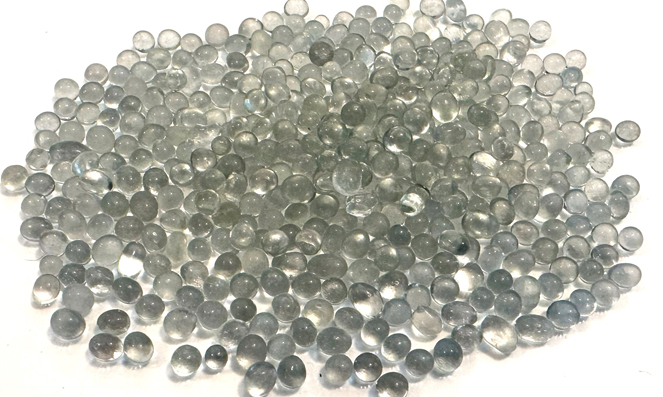
DOMILL High-Precision Glass Beads are manufactured from high-purity soda-lime glass, processed via high-temperature flame spherical melting, annealing, and precision screen classification.
The resulting glass spherical media is crystal clear, highly round, smooth, and chemically inert.
Designed for pneumatic dry and wet blasting cabinets, high-precision glass beads utilize spherical impact geometry rather than abrasive cutting. This ensures zero dimensional change on critical component tolerances while removing light surface corrosion, heat-treat scale, carbon deposits, and shop soil. Furthermore, glass beads produce a homogenous, visually appealing satin/matte finish on stainless steel fabrications, aluminum enclosures, and medical instruments while relieving mild tensile stress.
(Note: Glass beads feature a Mohs hardness of 6.0. For heavy mill scale descaling, aggressive deburring, or longer recycling durability, consider upgrading to DOMILL White Fused Alumina (Al2O3≥99%) or DOMILL Brown Fused Alumina series.)
Ferrous Cross-Contamination & Flash Rusting: Blasting stainless steel or aluminum with steel shot embeds iron dust into the matrix, triggering galvanic corrosion and unsightly yellow rust spots. Glass beads are completely iron-free and non-contaminating.
Inconsistent Surface Sheen & Scratch Camouflaging: Machining marks, scratches, and weld heat discoloration mar product aesthetics. Glass beads hammer microscopic, light-diffusing dimples onto the surface, concealing flaws under a uniform satin luster.
Inconsistent Surface Sheen & Scratch Camouflaging: Machining marks, scratches, and weld heat discoloration mar product aesthetics. Glass beads hammer microscopic, light-diffusing dimples onto the surface, concealing flaws under a uniform satin luster.
|
Classification |
Property / Element |
Control Specification / Typical Value |
Technical Context & Guidance |
|
Physical Spec |
Particle Shape |
Highly Smooth Spherical / Round |
Non-cutting geometry ensures precision non-destructive finishing |
|
|
Sphericity (Roundness) |
≥80% (High-Precision Grade ≥85%–90%) |
High roundness prevents surface scratching from broken bits |
|
|
Specific Gravity |
2.4–2.6 g/cm3 (Typical 2.5 g/cm3) |
Balanced mass for fluid pneumatic conveyance in suction guns |
|
|
Bulk Density |
1.5–1.6 g/cm3 |
Calibrated for pressure pot and suction cabinet feed lines |
|
|
Mohs Hardness |
6.0 Mohs (~550 HV) |
Moderate hardness that shields steel, aluminum, and mold faces |
|
|
Refractive Index |
≥1.51 |
High-clarity amorphous soda-lime matrix |
|
|
Free Magnetic Iron |
<0.1% |
Strictly iron-free for nuclear, marine, and medical compliance |
|
Chemical Analysis |
SiO2 |
70.00% – 75.00% |
Amorphous silicate glass structure; zero free crystalline silica |
|
|
Na2O |
12.00% – 15.00% |
Glass fluxing agent optimizing structural density |
|
|
CaO |
7.00% – 11.00% |
Stabilizing oxide enhancing mineral hardness |
|
|
MgO |
2.00% – 5.00% |
Chemical resistance lattice oxide |
|
|
Al2O3 |
0.50% – 2.50% |
Trace alumina strengthening the glass matrix |
3.1 Physical & Chemical Specifications Table
|
Classification |
Property / Element |
Control Specification / Typical Value |
Technical Context & Guidance |
|
Physical Spec |
Particle Shape |
Highly Smooth Spherical / Round |
Non-cutting geometry ensures precision non-destructive finishing |
|
|
Sphericity (Roundness) |
≥80% (High-Precision Grade ≥85%–90%) |
High roundness prevents surface scratching from broken bits |
|
|
Specific Gravity |
2.4–2.6 g/cm3 (Typical 2.5 g/cm3) |
Balanced mass for fluid pneumatic conveyance in suction guns |
|
|
Bulk Density |
1.5–1.6 g/cm3 |
Calibrated for pressure pot and suction cabinet feed lines |
|
|
Mohs Hardness |
6.0 Mohs (~550 HV) |
Moderate hardness that shields steel, aluminum, and mold faces |
|
|
Refractive Index |
≥1.51 |
High-clarity amorphous soda-lime matrix |
|
|
Free Magnetic Iron |
<0.1% |
Strictly iron-free for nuclear, marine, and medical compliance |
|
Chemical Analysis |
SiO2 |
70.00% – 75.00% |
Amorphous silicate glass structure; zero free crystalline silica |
|
|
Na2O |
12.00% – 15.00% |
Glass fluxing agent optimizing structural density |
|
|
CaO |
7.00% – 11.00% |
Stabilizing oxide enhancing mineral hardness |
|
|
MgO |
2.00% – 5.00% |
Chemical resistance lattice oxide |
|
|
Al2O3 |
0.50% – 2.50% |
Trace alumina strengthening the glass matrix |
|
Grade / Mesh Size |
Particle Size (μm) |
Primary Application |
Surface Finish & Visual Texture |
|
20/30 Mesh (AH) |
600 – 850 μm |
Heavy die-casting cleaning, tire mold maintenance |
High impact energy for shattering heavy rubber bake-on |
|
30/40 Mesh (A) |
425 – 600 μm |
Coarse stainless steel weld cleaning, large castings |
Rapid cleaning; builds a noticeable textured matte profile |
|
40/70 Mesh (B) |
212 – 425 μm |
Industry Standard Grade for Stainless/Aluminum |
Benchmark size; ideal balance of speed and satin sheen |
|
70/100 Mesh (C) |
150 – 212 μm |
Consumer electronics enclosures (laptops), medical |
Produces a silky, soft-touch satin finish with great aesthetics |
|
100/170 Mesh (D) |
90 – 150 μm |
Engine valves, precision deburring, aero peening |
Non-destructive removal of micro-burrs; builds light residual stress |
|
170/325 Mesh (E) |
45 – 90 μm |
Instrument hardware, ultra-fine satin polishing |
High particle density per impact; creates flawless matte luster |
|
200/325 Mesh (F) |
45 – 75 μm |
Optical hardware, maintenance of textured molds |
Protects fine mold etching while generating pristine satin profiles |
100% Iron-Free & Non-Contaminating: Pure soda-lime glass contains zero free iron, eliminating cross-contamination and flash rust on stainless steel and aluminum.
|
Operating Condition & Application |
Recommended Abrasive |
Selection Rationale & Upgrade Benefit |
Cost & Efficiency Impact |
|
Non-Destructive Mold Maintenance & Satin Finishing |
DOMILL High-Precision Glass Beads |
Non-Destructive Satin Media; spherical non-cutting action, zero dimensional loss, 100% iron-free |
Lowest initial cost for precision mold maintenance and cosmetic finishing |
|
Aggressive Non-Ferrous Deburring & Long Recycle Life |
Upgrade to DOMILL White Fused Alumina (WFA) Fines |
Hardness Jump (Mohs 9.0 vs 6.0); sharp WFA cuts tough burrs fast; 3–5x longer recycling lifetime |
Slashes deburring labor hours; reduces media turnover in closed blast cabinets |
|
Carbon Steel Heavy Descaling & Blast Room Recovery |
Upgrade to DOMILL Brown Fused Alumina (BFA) |
Functionality Jump (Cutting vs Dimpling); BFA (Mohs 9.0) shears scale effortlessly, yielding 10–15+ reuses |
50%–100% faster stripping speeds; lowers total long-term operational costs |
Scenario 1: Precision Mold Maintenance & Matte Surface Finishing for Stainless Steel Components
Ideal for protecting precision mold cavity tolerances and delivering silky satin finishes on consumer stainless steel and aluminum enclosures.
Scenario 2: Stubborn Burr Removal on Stainless Steel/Aluminum & Extended Media Recycling Lifespan
Glass beads (Mohs 6.0) break down after 2–3 impact passes when encountering hard burrs. Upgrading to DOMILL White Fused Alumina Fines (F150–F320, Al2O3≥99%, Mohs 9.0) maintains 100% iron-free purity while shearing heavy burrs rapidly and extending media recycling lifetime by 3–5 times.
Scenario 3: Heavy-Duty Rust Removal & Thick Mill Scale Descaling for Carbon Steel Structural Parts
Glass beads lack the cutting facets needed to break heavy hot-rolled scale. For carbon steel blast cleaning, upgrade to DOMILL Brown Fused Alumina (Mohs 9.0) for 10–15+ recycling passes and double the stripping speed.
Precision Mold Maintenance & Cleaning: Removes carbonized rubber bake-on and residue from tire and injection mold cavities without eroding sharp edges or textured geometries.
Aerospace & Automotive Light Peening: Cleans turbine blades and engine valves non-destructively while imparting beneficial compressive residual stresses.
Q: Why do glass beads produce a softer satin finish on stainless steel than fused alumina?
A: Fused alumina is angular and micro-machines sharp, jagged valleys that produce a coarse matte texture. Glass beads are smooth spheres that form smooth, shallow dimples upon impact. These rounded dimples diffuse light evenly, creating a silky, soft-touch satin sheen.
Q: Glass beads break quickly and clean slowly when deburring hard aluminum castings. What is the optimal upgrade?
A: We strongly recommend upgrading to DOMILL White Fused Alumina (WFA) Fines (e.g., F180, F220, F240):
1. Hardness Advantage: Glass beads (Mohs 6.0) shatter against hard burrs. WFA (Mohs 9.0) shears off tough casting flash effortlessly;
2. Iron-Free Purity: WFA (Al2O3≥99%) contains zero iron, matching glass beads’ anti-corrosion safety;
3. Extended Reusability: WFA features superior toughness, yielding 3–5x longer recycling life in blast cabinets while cutting processing time dramatically.
Please fill out the form.We will reply you in 24 hours.